If you’ve experimented with AI tools over the past couple of years, you’ve probably felt the same frustration: they promise efficiency but often introduce a new kind of mental overhead. You end up spending time figuring out what to ask, re-explaining context, tweaking tone, and fixing outputs that are technically correct but practically useless.
That’s why Sintra.ai stood out to me. It doesn’t try to be clever or futuristic for the sake of it. Instead, it makes a simple, grounded promise:
“What if AI worked like employees with clear roles instead of a blank chat box?”
After digging deep into the platform, user feedback, and real-world workflows, I can confidently say this: Sintra is one of the few AI tools that actually feels designed for how people work, not how AI engineers think.
What Sintra.ai Is (Without the Buzzwords)
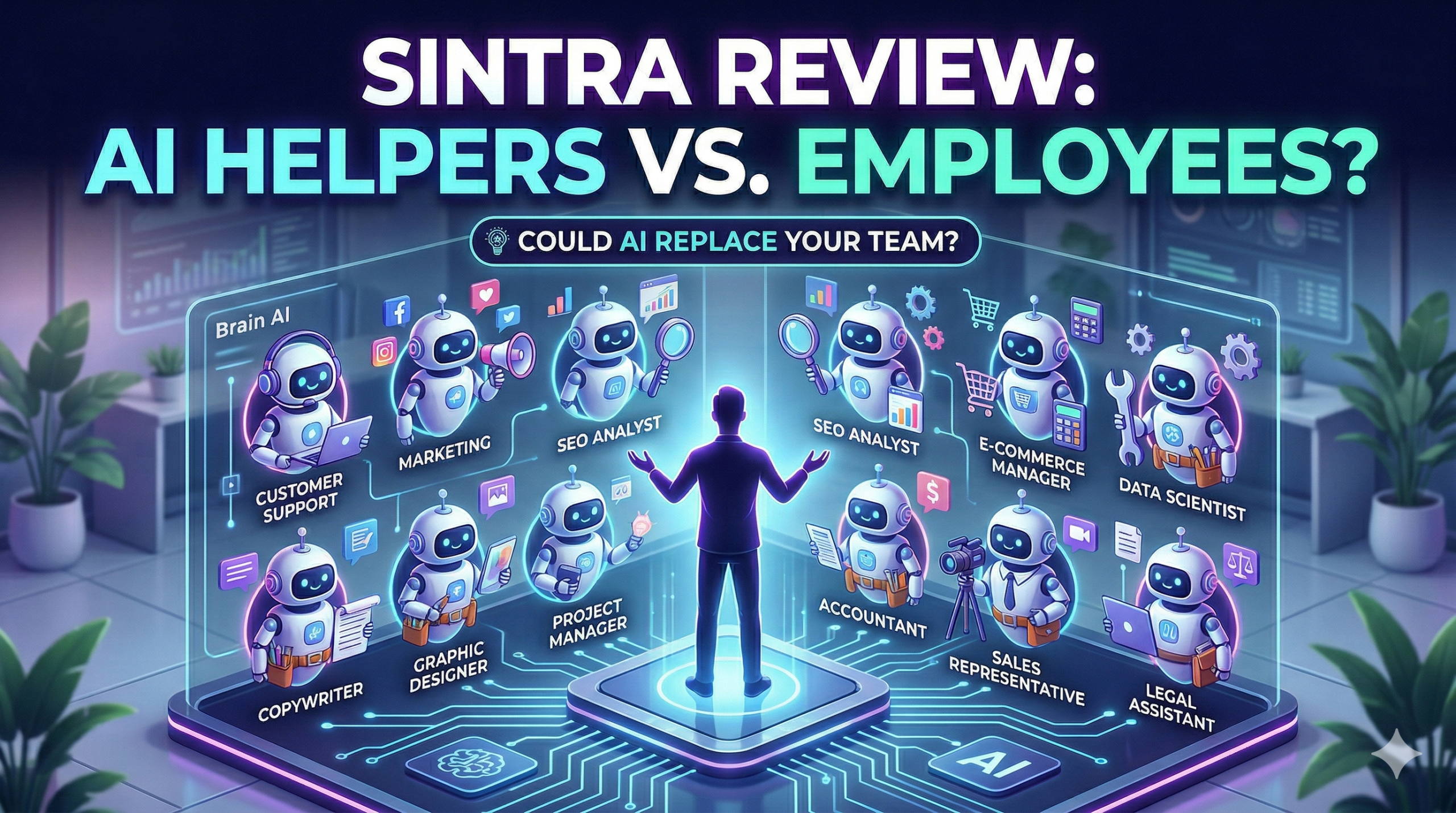
Sintra.ai is a business productivity platform built around specialized AI helpers. Instead of opening a single chatbot and hoping it understands what you need, you choose a specific role, such as marketing, sales, admin, customer support, or content creation. Each helper is designed to behave like someone hired for that particular job.
This might sound like a small UX decision, but in practice, it completely changes how you interact with AI. You stop “prompting” and start delegating — and that’s a crucial distinction.
Why the “AI Employees” Concept Actually Works
Most AI tools assume the user is willing to learn how to work with AI. Sintra makes the opposite assumption: You already have work to do.
By giving each helper a defined role, Sintra removes the biggest friction point in AI usage—figuring out how to ask. You don’t need to know how to write a perfect marketing prompt. You just talk to the marketing helper. You don’t need to structure an admin workflow. You ask the admin helper. This role-based setup makes Sintra especially appealing to founders, freelancers, and small business owners who don’t want to become AI specialists.
Brain AI: The Quietly Brilliant Core Feature
If there’s one feature that truly sets Sintra apart, it’s Brain AI.
Brain AI acts as a shared memory layer for your business. This is where you define:
- What your company does
- Your brand voice and tone
- Your audience
- Writing preferences
- Key background information
Once this is set up, every AI helper automatically references it. This solves one of the most common AI pain points: repetition. You’re not re-explaining your brand voice. You’re not correcting tone every time. You’re not reminding the AI who your audience is. Over time, this creates something rare in AI tools: consistency.
A Day-in-the-Life Example (How Sintra Is Actually Used)
To make this more concrete, here’s how a solo founder might realistically use Sintra in a normal workday:
Morning
| Monday | Midday | Afternoon |
| Admin helper summarizes emails and notes priorities | Sales helper creates a follow-up email for warm leads | Customer support helper drafts replies to common questions |
| Marketing helper drafts a LinkedIn post and newsletter idea | Content helper outlines a blog post | Admin helper helps plan tasks for tomorrow |
None of these tasks are revolutionary on their own. But taken together, they remove a surprising amount of mental clutter. That’s where Sintra’s value really shows.
Ease of Use: One of Sintra’s Strongest Advantages
Sintra is genuinely easy to use — and that’s not something you can say about many AI platforms. There’s no heavy onboarding process, no need to spend hours reading documentation, and no lingering sense that you’re underutilizing the tool. Most users can sign up and start getting real value within 10–15 minutes. It’s clearly a product built for busy founders, non-technical users, and people who care more about outcomes than features.
Multilingual Support: An Underrated Strength
Sintra supports 100+ languages, which quietly makes it especially useful for international businesses, multilingual customer support, and global content creation. While this capability isn’t always front and center in their marketing, it’s a meaningful advantage for companies operating across borders.
Pricing: Is Sintra.ai Worth Paying For?
Sintra typically offers two main approaches:
- A single-helper plan if you only need one function
- A full-suite plan that unlocks all helpers and Brain AI
For most users, the full plan offers the best value. When you compare the cost to hiring even a part-time assistant o restacking multiple AI subscriptions, the pricing feels realistic and fair. This isn’t priced for enterprises with procurement departments. It’s priced for individuals and small teams paying from their own budget.
Check current Sintra.ai pricing here
Output Quality: Practical Over Flashy
Sintra’s outputs are best described as strong first drafts. They may not always deliver the most creative copy on the first attempt, but they consistently provide clean structure, clear language, and an on-brand tone (powered by Brain AI). Most importantly, they significantly reduce revision time. For most business users, saving time matters more than perfect prose.
Where Sintra.ai Falls Short (Honest Downsides)
To be credible, it’s important to acknowledge where Sintra may not be the ideal fit.
If your workflow depends heavily on complex automations or API-driven systems, Sintra can feel limited compared to tools built with automation as their core focus. Advanced users who enjoy deep prompt engineering may also find the platform slightly restrictive in terms of flexibility and control. While Sintra handles common workflows effectively, it isn’t designed for highly complex or multi-layered automation chains.
These aren’t flaws so much as intentional design choices — but they can be important depending on your specific needs.
Who Sintra Is NOT For
Sintra may not be the right choice if you:
- Are an AI developer or engineer
- Need heavy enterprise integrations
- Want full control over prompts and system behavior
- Build custom AI pipelines
In those cases, more technical platforms may suit you better. Sintra is optimized for execution, not experimentation.
Sintra.ai vs Other AI Tools
Here’s how Sintra compares at a high level:
| AI Tool | Features |
| Sintra.ai | Best for founders & SMBs who want simplicity |
| ChatGPT | Best for power users and flexibility |
| Jasper AI | Strong for dedicated marketing teams |
| Notion AI | Best inside documentation workflows |
Sintra wins when clarity, speed, and low friction matter more than endless customization.
Customer Feedback & Real-World Sentiment
Across user reviews, several themes come up consistently:
- “Feels like having a small team”
- “Much easier than ChatGPT”
- “Saves me hours every week”
Criticism usually centers around:
- Wanting more integrations
- Wanting deeper control
Overall sentiment is strongly positive, particularly among founders and freelancers.
Frequently Asked Questions (FAQ)
- Is Sintra.ai safe to use for business data?
- Sintra positions itself as a business-grade platform, but like any AI tool, sensitive data should be handled carefully.
- Can Sintra replace employees?
- No — and it shouldn’t. Sintra is best viewed as a productivity multiplier, not a replacement for human judgment.
- Is Sintra better than ChatGPT?
- It depends. ChatGPT offers more flexibility. Sintra offers more structure and ease of use.
- Does Sintra work for non-English businesses?
- Yes. With support for 100+ languages, it’s well-suited for international use.
Final Verdict: Is Sintra.ai Worth It?
Sintra.ai doesn’t try to overwhelm users with endless features or technical complexity. Instead, it focuses on something far more valuable: reducing friction in everyday business tasks. Using it feels less like “working with AI” and more like delegating the tasks you don’t want to handle yourself. For founders, freelancers, and small teams, that simplicity can be incredibly powerful.
Overall Rating: 4.5 / 5