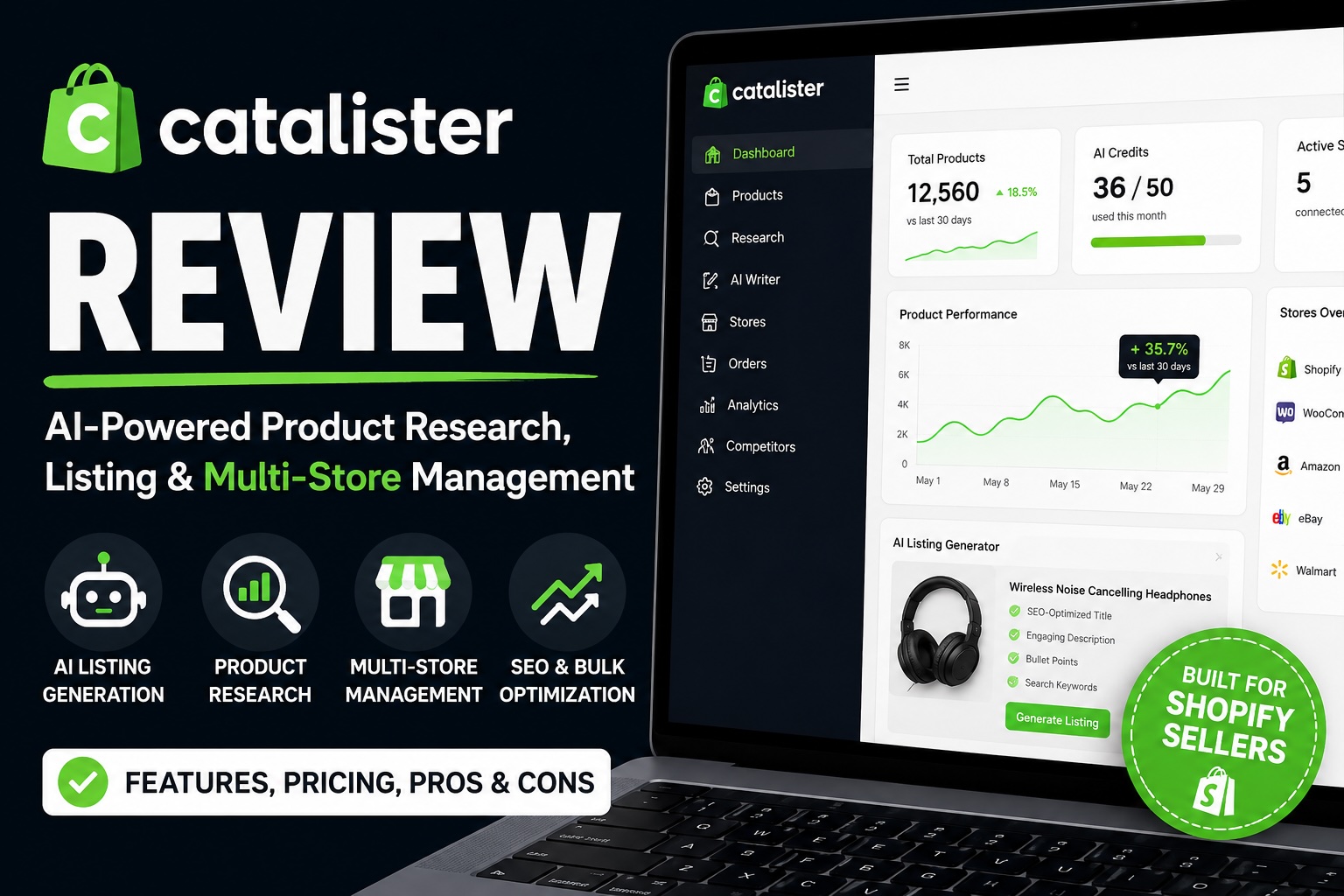
Catalister review searches have increased as more Shopify sellers, dropshippers, and ecommerce operators look for AI tools that can speed up product research and listing creation. Catalister positions itself as an AI-powered ecommerce platform focused on product sourcing, SEO-friendly listings, multi-store management, and workflow automation for online sellers.
Instead of acting as a traditional ecommerce platform, Catalister sits on top of existing stores and marketplaces. The goal is to reduce the repetitive work involved in finding products, creating listings, optimizing descriptions, and managing multiple stores from a single dashboard.
What is Catalister? Catalister is an AI-powered ecommerce tool designed to help online sellers automate product research, listing creation, SEO optimization, and multi-store management. It supports workflows for Shopify and other marketplaces while offering AI-generated product descriptions, bulk editing, analytics, and competitor tracking features for ecommerce businesses.
What Is Catalister?
Catalister is primarily built for ecommerce sellers who want to scale product uploads and optimize listings faster. The platform focuses heavily on AI-assisted product listing generation and workflow automation rather than full ecommerce store hosting.
The platform appears especially targeted toward Shopify sellers, dropshippers, and multi-channel ecommerce businesses. Users can import products, generate titles and descriptions with AI, optimize image SEO, and manage listings across connected stores.
Several independent reviews also mention features such as competitor tracking, keyword integration, bulk product editing, analytics dashboards, and marketplace monitoring. However, some details vary depending on the source and plan tier, so prospective buyers should confirm exact feature availability directly with Catalister before subscribing.
One thing worth noting is that Catalister uses a credit-based AI system. AI-generated listings consume credits, while some manual imports do not. This pricing structure is one of the platform’s most discussed aspects among users.
For ecommerce businesses handling hundreds of listings each month, understanding how credits work is important before committing to a plan.
Catalister review: Core Features
Most users considering Catalister are evaluating whether the automation features actually save time compared to manual ecommerce workflows. Based on publicly available information and feature breakdowns, these are the platform’s main capabilities.
AI Listing Creation
The platform’s main feature is AI-generated ecommerce listings. Users can import a product and let the AI generate titles, descriptions, bullet points, SEO elements, and marketplace-ready content.
According to independent reviews, Catalister pulls keyword data into listings to improve search visibility. This can help ecommerce sellers reduce the time spent manually rewriting supplier descriptions.
That said, AI-generated ecommerce copy still requires review. Most reviewers mention that listings often need adjustments for tone, technical details, branding consistency, and compliance.
Product Research Tools
Catalister also includes product research and competitor analysis features. Users can reportedly track trending products, pricing behavior, sales trends, and competitor activity across marketplaces.
This positions the platform somewhere between a listing optimization tool and a lightweight ecommerce intelligence platform.
However, sellers focused purely on Amazon research may still prefer more specialized tools like Helium 10 or Jungle Scout, which offer deeper Amazon-specific analytics.
Bulk Product Management
Bulk editing is another major focus. Ecommerce sellers with large catalogs can reportedly update descriptions, metadata, titles, pricing, and categories across multiple products simultaneously.
For stores managing hundreds or thousands of SKUs, this is one of the platform’s more practical features. Bulk operations often matter more than AI generation itself once catalogs become large.
Multi-Store and Multi-Channel Support
Multiple sources mention integrations with Shopify, WooCommerce, BigCommerce, Walmart, Amazon, and eBay. Users can reportedly manage listings across several stores from a centralized dashboard.
This makes Catalister more attractive for agencies, dropshippers, and ecommerce operators running multiple storefronts simultaneously.
SEO and Image Optimization
Some higher-tier plans include image SEO tools, automated alt text generation, meta descriptions, and category tagging.
These are not groundbreaking features individually, but together they can reduce repetitive optimization work for ecommerce teams.
Analytics and Performance Tracking
Catalister also includes analytics functionality through tools such as “Analister,” which reportedly tracks product performance and ad-related metrics.
While this is useful for getting a centralized overview, most advanced ecommerce businesses will still rely on dedicated analytics platforms for deeper reporting.
Catalister review: Use Cases
Catalister is not necessarily designed for every ecommerce business. Its value depends heavily on how many products you manage and how repetitive your workflow has become.
Dropshipping Businesses
Dropshippers are probably the platform’s clearest target audience. Many dropshipping stores need to launch products quickly, rewrite supplier descriptions, and test products rapidly.
AI-generated listings combined with bulk import functionality can reduce the time spent launching products.
Shopify Store Owners
Shopify sellers running medium-sized catalogs may benefit from the centralized workflow tools. Instead of manually updating metadata and descriptions product by product, Catalister attempts to streamline the process.
Agencies Managing Multiple Stores
Agencies and ecommerce operators running multiple brands may benefit from multi-store support and collaborative workflows.
Features like templates, role management, and bulk editing become more useful when multiple team members are involved.
Small Ecommerce Teams
Small ecommerce businesses without dedicated content teams may also find value in AI-assisted listing generation. Instead of hiring copywriters for every product launch, teams can use AI as a starting point and edit the final result manually.
However, businesses requiring highly customized branding or premium editorial product copy may still prefer human-written descriptions.
Catalister Pricing
Catalister pricing varies depending on the source, and the platform appears to have adjusted plans over time. Based on multiple independent reviews, the platform currently offers several subscription tiers with AI credit limitations.
- Starter plans reportedly begin around €14.99 to €39 per month
- Mid-tier plans range between approximately €24.99 and €129 per month
- Enterprise pricing is custom
- Most standard plans appear to include around 50 AI credits monthly
- Additional credits can be purchased separately
The credit structure is one of the platform’s biggest strengths and weaknesses.
For small sellers uploading a limited number of products, the pricing can be relatively affordable. However, larger ecommerce stores generating many AI listings each month may quickly exceed the included credit allocation.
Some reviewers specifically criticized the non-rollover credit system and noted confusion around which actions consume credits.
Before subscribing, it is worth carefully reviewing:
- How many listings you generate monthly
- Whether credits roll over
- How overage pricing works
- Which features are restricted to higher plans
- How many stores each plan supports
Catalister does offer a free trial according to several public reviews, which is probably the best way to evaluate whether the workflow matches your business needs.
Pros and Cons
Pros
- Fast listing generation: AI-generated descriptions and titles can significantly reduce manual ecommerce work.
- Useful for multi-store workflows: Managing multiple stores from one dashboard is convenient for agencies and scaling sellers.
- Bulk editing capabilities: Large product catalogs become easier to manage.
- SEO-focused tools: Keyword integration, image SEO, and metadata features help streamline optimization.
- Accessible pricing entry point: Lower-tier plans appear relatively affordable for smaller ecommerce businesses.
- Integrations with major ecommerce platforms: Shopify, WooCommerce, and marketplace support increase flexibility.
Cons
- Credit system limitations: Many users mention that monthly AI credits can run out quickly.
- AI output still needs editing: Listings are not fully publish-ready in many cases.
- Pricing structure can feel confusing: Some reviewers reported uncertainty around overage costs and feature access.
- Mixed public reviews: Trustpilot ratings currently appear inconsistent.
- Some integrations reportedly remain limited or in development: Certain marketplace connectors may not be as mature as established competitors.
Catalister vs Competitors
When evaluating Catalister alternatives, the biggest question is whether you need a broad multi-channel workflow tool or a highly specialized ecommerce research platform.
Catalister vs Helium 10
Helium 10 is significantly stronger for Amazon-specific keyword research, PPC optimization, and marketplace analytics.
Catalister, however, appears more focused on multi-store workflows and AI listing automation across several ecommerce platforms.
If your business operates almost entirely on Amazon, Helium 10 likely remains the more advanced solution. If you run Shopify stores alongside multiple channels, Catalister may fit better.
Catalister vs Jungle Scout
Jungle Scout is another Amazon-focused competitor with stronger marketplace intelligence and product research depth.
Catalister’s advantage lies more in workflow automation, AI-assisted listing generation, and centralized ecommerce management.
Again, the choice depends heavily on whether your business is Amazon-centric or multi-channel.
Catalister vs Sellbery
Sellbery focuses heavily on multi-channel product synchronization and feed management. Catalister attempts to combine similar workflow functionality with AI listing creation and ecommerce optimization tools.
Businesses prioritizing AI-assisted listing generation may prefer Catalister, while businesses focused purely on feed synchronization may find Sellbery sufficient.
Compared to most competitors, Catalister’s biggest differentiator is probably its attempt to combine ecommerce automation, AI copy generation, SEO optimization, and multi-store management into one system.
FAQ
Is Catalister good for beginners?
Catalister appears beginner-friendly in terms of interface and onboarding. However, understanding the credit system and configuring workflows may still require some learning, especially for new ecommerce sellers.
Does Catalister work with Shopify?
Yes. Shopify integration is one of the platform’s primary use cases according to both the official website and independent reviews. Several sources describe Catalister as especially focused on Shopify workflows.
How does Catalister pricing work?
Catalister uses subscription plans combined with AI usage credits. AI-generated listings consume credits, while some manual product import methods reportedly do not.
Is Catalister worth it for large ecommerce stores?
It depends on listing volume. Large ecommerce stores may benefit from automation and bulk editing features, but businesses generating many AI listings monthly should calculate additional credit costs carefully.
What are the best Catalister alternatives?
Popular alternatives include Helium 10, Jungle Scout, and Sellbery. The best choice depends on whether you need Amazon-focused analytics, multi-channel management, or AI-driven listing automation.
Is Catalister Worth It?
For ecommerce businesses that regularly upload products and manage multiple storefronts, Catalister can potentially save a meaningful amount of time.
The platform’s strongest value proposition is workflow acceleration. AI-generated listings, bulk editing, and centralized store management reduce repetitive tasks that ecommerce operators often spend hours handling manually.
However, the platform is probably less compelling for:
- Very small stores with only a few products
- Businesses needing highly customized premium copywriting
- Amazon sellers who want deep marketplace analytics
- Users who dislike credit-based pricing systems
The mixed Trustpilot reviews also suggest buyers should test the platform thoroughly during the free trial before fully committing.
Overall, Catalister seems most useful for scaling ecommerce operators who value speed and workflow efficiency more than perfect AI-generated copy.
Final Verdict
Catalister fills a practical niche in the ecommerce automation market. The platform combines AI-assisted listing generation, product research, bulk editing, SEO tools, and multi-store workflows into a relatively accessible package.
Its biggest strengths are speed and workflow simplification. For ecommerce sellers constantly uploading and optimizing products, those efficiencies can matter more than advanced AI sophistication.
At the same time, the platform is not without tradeoffs. The credit system may frustrate high-volume users, AI output still requires human editing, and some competing tools offer deeper analytics in specific ecommerce niches.
Still, for Shopify-focused ecommerce teams and multi-store sellers looking to automate repetitive listing work, Catalister is a credible option worth evaluating.
Overall Rating: ★★★★☆ (4.0 / 5)
👉 Try Catalister here and see if it fits your workflow