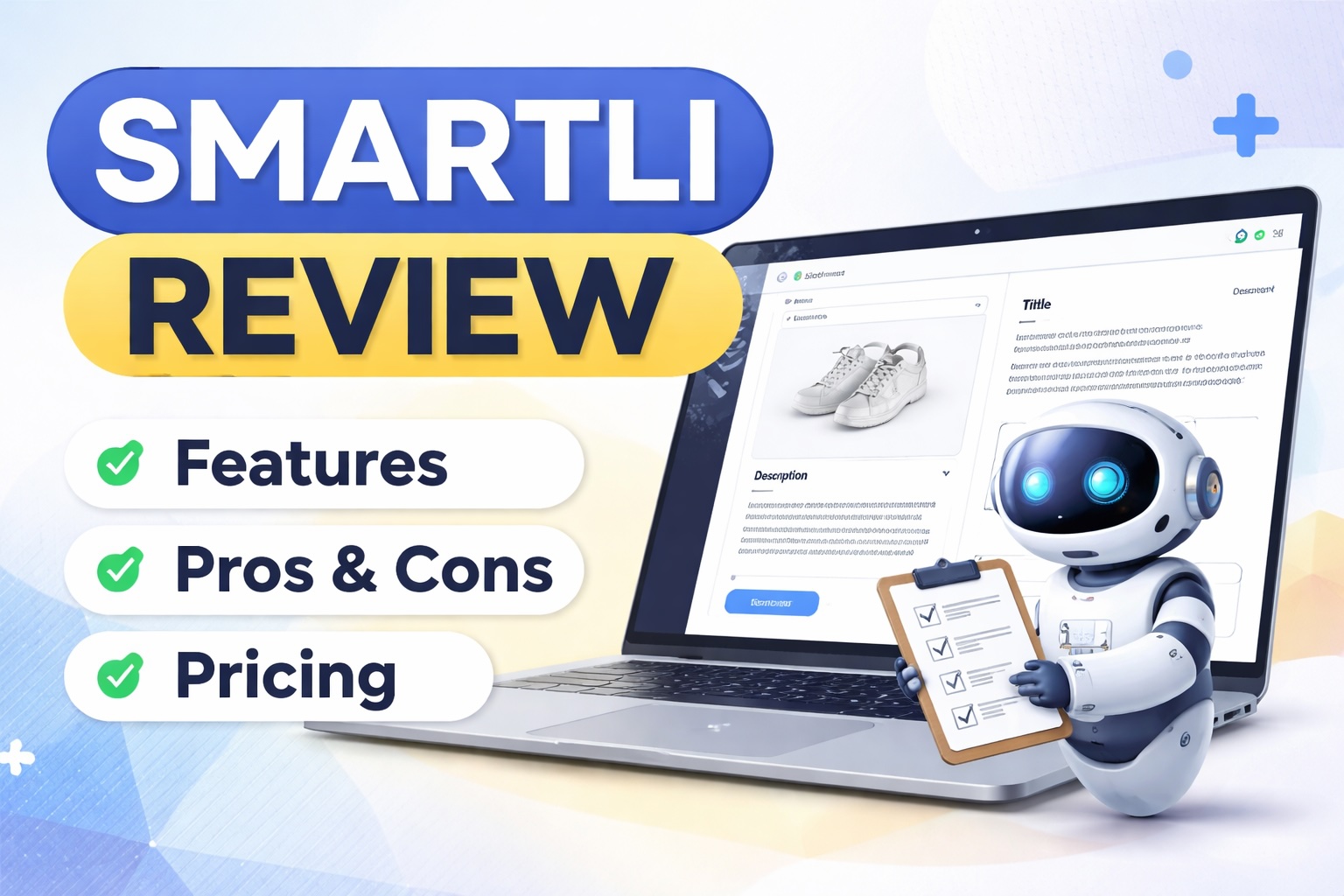
Writing product descriptions at scale is one of those operational tasks that quietly slows down ecommerce growth. It starts manageable, but once your catalog expands, maintaining quality and consistency becomes difficult. In this Smartli review, we take a grounded look at whether this tool actually helps solve that problem, or simply adds another layer to your workflow.
What is Smartli? Smartli is an AI-powered ecommerce writing tool designed to generate product descriptions, titles, and listing content from structured inputs. It helps businesses create consistent, ready-to-edit product copy faster, reducing manual writing effort while maintaining a standardized format across large catalogs.
What Is Smartli?
Smartli is a specialized AI content tool built for ecommerce teams that need to produce product descriptions at scale. Instead of functioning as a general writing assistant, it focuses narrowly on product listings and related content.
The way it works is relatively straightforward. You provide product information such as features, specifications, or key selling points. Smartli then generates structured text that can be used as a first draft. From there, you review, edit, and publish.
This places Smartli directly in the operational layer of ecommerce workflows. It is not meant to replace strategy or branding decisions. It is designed to reduce the time spent on repetitive writing tasks while maintaining a consistent format across listings.
If you are trying to understand how to use Smartli in practice, the simplest way to think about it is as a drafting tool. It helps you go from raw product data to structured copy more quickly, but still requires human oversight.
Smartli review: Core Features
Rather than presenting a long list of features, it is more useful to look at what Smartli actually enables in day to day work.
AI-generated product descriptions
The primary function of Smartli is generating product descriptions based on structured inputs. This reduces the need to write each listing manually and can significantly speed up content production.
The output is typically usable as a draft rather than a final version. You still need to refine tone, ensure accuracy, and align with your brand voice.
Standardized content structure
One of the more practical Smartli features is consistency. When different team members write product descriptions, variations in style often appear. Smartli helps enforce a more uniform structure across listings.
Workflow efficiency
Instead of spending time drafting from scratch, teams can shift toward reviewing and editing. This is where most of the time savings occur, particularly for stores with large inventories.
Ecommerce-focused output
Unlike general AI tools, Smartli is tuned for product content rather than blogs or long form marketing copy. This makes it more relevant for ecommerce, but less flexible outside that scope.
These Smartli features collectively position it as a production tool rather than a creative writing assistant.
Smartli review: Use Cases
To understand where Smartli fits, it is important to look at real scenarios rather than theoretical benefits.
Scaling product catalogs
If you are adding a large number of products to your store, Smartli can help generate descriptions quickly. Instead of writing each one manually, you can create drafts in batches and refine them.
Agency content production
Agencies working with multiple ecommerce clients often need to produce content at scale. Smartli can act as a baseline generator, allowing teams to maintain efficiency while still customizing output per client.
Improving existing listings
If your current product descriptions are inconsistent or outdated, Smartli can help standardize them. This is particularly useful during rebranding or catalog optimization projects.
When Smartli is not a good fit
Smartli is not well suited for long form content such as blog posts or email campaigns. It may also struggle with highly technical products that require precise language. In those cases, manual writing or specialized tools are still necessary.
Understanding these boundaries is important when evaluating whether Smartli alternatives might be more appropriate.
Pricing and Value Analysis
At the time of writing, Smartli pricing is not fully transparent or may vary depending on plan structure. Because of this, it is important to verify details directly on the official website.
From a value perspective, the main factor is output volume. If you are producing a large number of product descriptions regularly, the time savings can justify the cost.
For smaller stores or occasional use, the value is less clear. In those cases, a general AI tool or manual process may be sufficient.
Overall, Smartli pricing should be evaluated based on how central product content generation is to your workflow.
Pros and Cons
Pros
- Built specifically for ecommerce content workflows
- Reduces time spent writing product descriptions
- Improves consistency across listings
- Easy to integrate into existing processes
- Useful for scaling large catalogs
Cons
- Limited to product-focused content
- Requires manual editing and verification
- Pricing structure is not fully clear
These Smartli pros and cons highlight its strength as a specialized tool rather than a complete content solution.
Smartli vs Competitors
To evaluate Smartli properly, it helps to compare it with broader AI writing platforms such as Jasper and Copy.ai.
Smartli vs Jasper
Jasper is a general purpose AI writing tool that supports blog posts, ads, emails, and more. Compared to Jasper, Smartli is narrower in scope. It is easier to use for ecommerce content, but lacks flexibility.
If your main need is product descriptions, Smartli may be more efficient. If you need a broader content tool, Jasper is the stronger option.
Smartli vs Copy.ai
Copy.ai offers a wide range of templates for marketing content. While it can generate product descriptions, it is not specifically optimized for ecommerce workflows in the same way Smartli is.
The trade off is clear. Smartli offers specialization, while Copy.ai offers versatility. Choosing between them depends on your primary use case.
For users comparing Smartli alternatives, this distinction is the key decision point.
FAQ
What is Smartli used for?
Smartli is used to generate product descriptions and ecommerce listing content. It helps reduce manual writing and improve consistency across product pages.
How to use Smartli effectively?
You input product data such as features or specifications, generate a draft, and then review and refine the output. It works best as a drafting tool rather than a fully automated solution.
Is Smartli better than Jasper?
It depends on your needs. Smartli is better for ecommerce content, while Jasper is better for broader writing tasks such as blogs and marketing copy.
Does Smartli require editing?
Yes, all AI-generated content should be reviewed and edited to ensure accuracy, tone, and alignment with your brand.
Is Smartli worth it for small stores?
For small catalogs, the benefits may be limited. For larger or growing stores, the time savings can make it more worthwhile.
Is Smartli Worth It?
Smartli is worth considering if you are dealing with ongoing product content at scale. It is particularly useful for ecommerce businesses and agencies that need to produce consistent listings efficiently.
However, if your needs are broader or less frequent, a general AI writing tool may be more practical. The decision ultimately depends on how central product descriptions are to your workflow.
In that sense, the answer to whether Smartli is worth it depends less on the tool itself and more on how you plan to use it.
Final Verdict
Smartli is a focused ecommerce writing tool that addresses a specific operational challenge. It helps teams generate product descriptions faster and maintain consistency across listings. Its strength lies in its specialization, but that also limits its flexibility.
Overall Rating: ★★★★☆ (4.0 / 5)