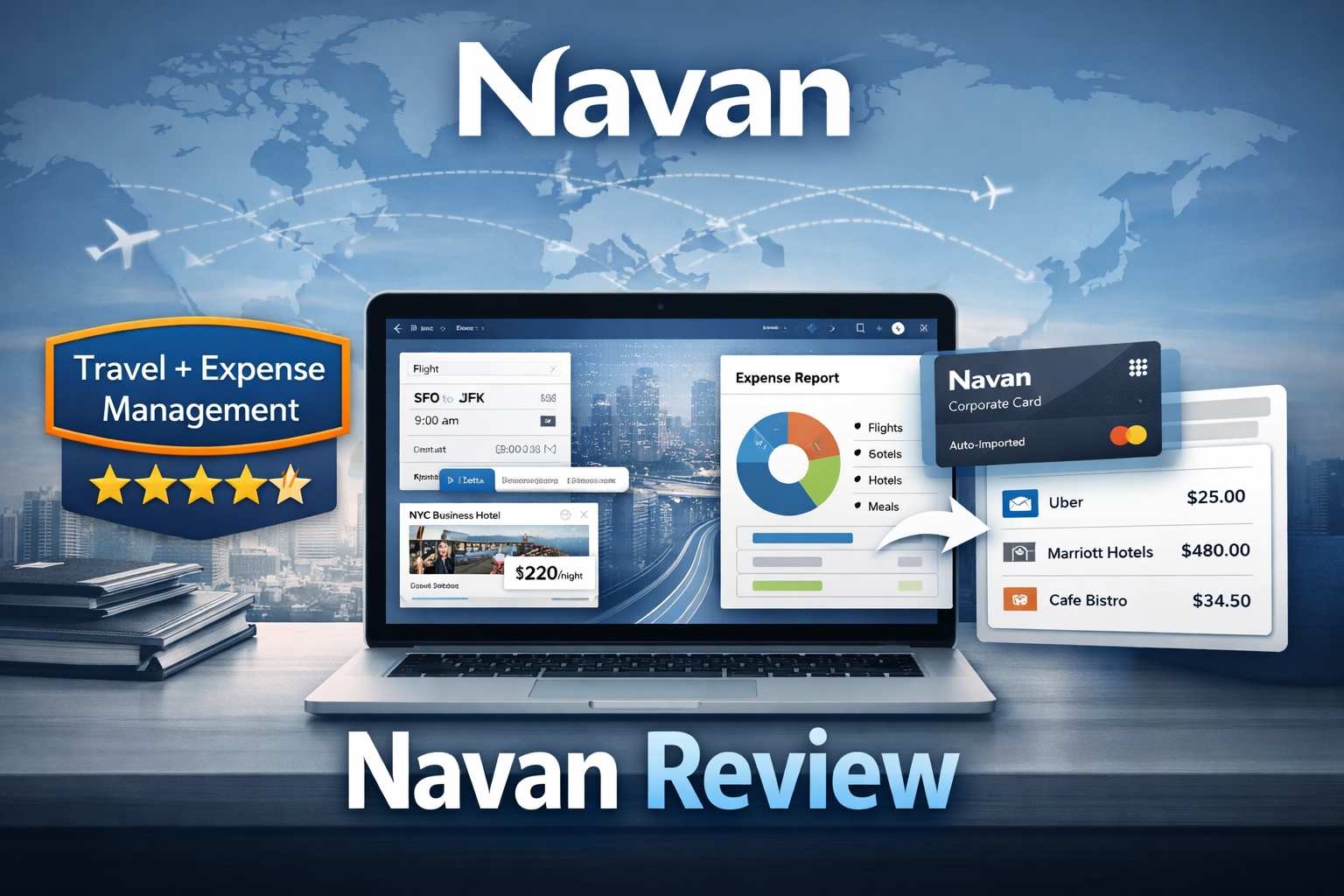
In this Navan review, I take a close look at one of the most widely used platforms for managing business travel and expenses in one place. If you are evaluating tools to streamline corporate travel, automate expense reporting, and improve financial visibility, Navan is likely already on your shortlist.
Navan is a travel and expense management platform that helps companies book business trips, track spending, and automate expense reporting in a unified system. It combines booking tools, corporate cards, and real-time expense visibility to reduce manual work and improve financial control.
What Is Navan?
Navan, previously known as TripActions, is a platform designed to manage business travel and corporate expenses in a single system. Instead of using separate tools for booking flights, handling reimbursements, and tracking budgets, Navan centralizes everything.
The platform combines three main elements. First, a travel booking system for flights, hotels, and transportation. Second, an expense management tool that automatically captures and categorizes spending. Third, corporate payment solutions, including virtual and physical cards.
This integrated approach is what differentiates Navan from traditional expense tools or standalone travel agencies. It is built for companies that want tighter financial control and less administrative overhead.
Navan review: Core Features
To understand whether Navan is worth it, you need to look at how its core features work together. The platform is not just a booking tool or an expense tracker. It is designed as an end-to-end workflow.
Unified Travel Booking
Navan allows employees to book flights, hotels, and rental cars within a single interface. The system includes corporate travel policies, so users only see compliant options based on company rules.
This reduces the need for manual approvals and ensures that spending stays within defined limits. Companies can also negotiate rates and apply them directly within the platform.
Automated Expense Management
One of the most important Navan features is automated expense capture. Transactions made with Navan cards are automatically recorded and categorized. Receipts can be uploaded via mobile, and the system matches them to transactions.
This significantly reduces manual entry and speeds up reimbursement processes. Finance teams benefit from cleaner data and fewer errors.
Corporate Cards and Payments
Navan provides both virtual and physical corporate cards. These are directly integrated into the expense system, meaning every transaction is tracked in real time.
Companies can set spending limits, enforce policies, and monitor usage without relying on separate banking tools.
Real-Time Reporting and Insights
Navan offers dashboards that provide visibility into travel and expense data. Finance teams can track spending trends, identify cost-saving opportunities, and ensure compliance.
This is particularly useful for larger organizations where visibility across departments is critical.
Policy Enforcement and Approvals
Instead of relying on manual checks, Navan enforces company policies directly in the booking and spending process. Approvals can be automated or triggered when exceptions occur.
This reduces friction for employees while maintaining control for finance teams.
Navan review: Use Cases
Navan is not designed for individual users. It is built for teams and organizations that deal with frequent travel and expense management.
- Mid-sized companies: Centralizing travel and expenses without building complex internal systems
- Finance teams: Reducing manual reconciliation and improving reporting accuracy
- High-growth startups: Scaling operations without adding administrative overhead
- Enterprises: Managing global travel policies and controlling spending across departments
If your company rarely handles travel or has very simple expense workflows, Navan may be more than you need. But for organizations with complexity, it becomes significantly more valuable.
Navan Pricing
Navan pricing is not fully transparent on the public website, which is common for enterprise-focused platforms. Pricing typically depends on company size, usage, and required features.
From available information, Navan generally monetizes through a combination of subscription fees, transaction-based costs, and potential savings-based models tied to travel bookings.
If you are evaluating Navan, you will likely need to request a demo or speak with sales to get accurate pricing tailored to your business.
This lack of transparent pricing can be a drawback, especially for smaller companies comparing multiple tools.
Navan Pros and Cons
Pros
- All-in-one platform for travel and expense management
- Strong automation reduces manual administrative work
- Real-time visibility into company spending
- Integrated corporate cards simplify reconciliation
- Policy enforcement built directly into workflows
Cons
- Pricing is not transparent and requires sales contact
- May be too complex for small teams with simple needs
- Initial setup and onboarding can take time
Overall, the pros clearly outweigh the cons for companies that actually need a unified system. But for smaller teams, the complexity and pricing structure may not be justified.
Navan vs Competitors
To properly evaluate this Navan review, it is important to compare it against alternatives like SAP Concur and Expensify. These tools approach the same problem from slightly different angles.
Navan vs SAP Concur
SAP Concur is one of the most established players in the space. It offers strong expense management and travel booking capabilities, but the user experience is often considered more complex.
Navan generally provides a more modern interface and tighter integration between travel and expenses. Concur, however, may be better suited for very large enterprises with highly customized workflows.
Navan vs Expensify
Expensify focuses primarily on expense management rather than full travel integration. It is simpler to set up and often more affordable for smaller teams.
Navan goes further by combining travel booking, payments, and expense tracking into one system. If travel is a major part of your operations, Navan offers a more complete solution.
In short, Expensify is better for simplicity, Concur for enterprise depth, and Navan for integrated workflows.
FAQ
What is Navan used for?
Navan is used to manage business travel bookings, track expenses, and control company spending in one platform. It replaces multiple tools by combining travel, payments, and expense workflows.
Is Navan suitable for small businesses?
Navan can be used by small businesses, but it is generally better suited for companies with frequent travel and more complex financial workflows. Smaller teams may prefer simpler tools.
How does Navan pricing work?
Navan pricing is typically customized based on company size and usage. You will need to contact their sales team to get a detailed quote.
Does Navan replace expense management tools?
Yes, Navan includes built-in expense management features. It can replace standalone tools by automating expense tracking and integrating it with travel and payments.
How to use Navan?
Users typically book travel directly within the platform, use corporate cards for payments, and upload receipts when needed. The system automatically tracks and categorizes expenses.
Is Navan Worth It?
Whether Navan is worth it depends on your company’s needs. If you manage frequent business travel, deal with complex expense workflows, or need better financial visibility, Navan offers clear value.
However, if your requirements are simple, a lighter tool may be more cost-effective. The key advantage of Navan is integration. If you do not need that integration, you may not fully benefit from the platform.
Final Verdict
Navan stands out as a comprehensive solution for managing business travel and expenses in a single system. Its strength lies in combining booking, payments, and expense tracking into one unified workflow.
While pricing transparency could be improved and onboarding may require effort, the overall value for mid-sized and larger organizations is strong.
Overall Rating: ★★★★☆ (4.5 / 5)