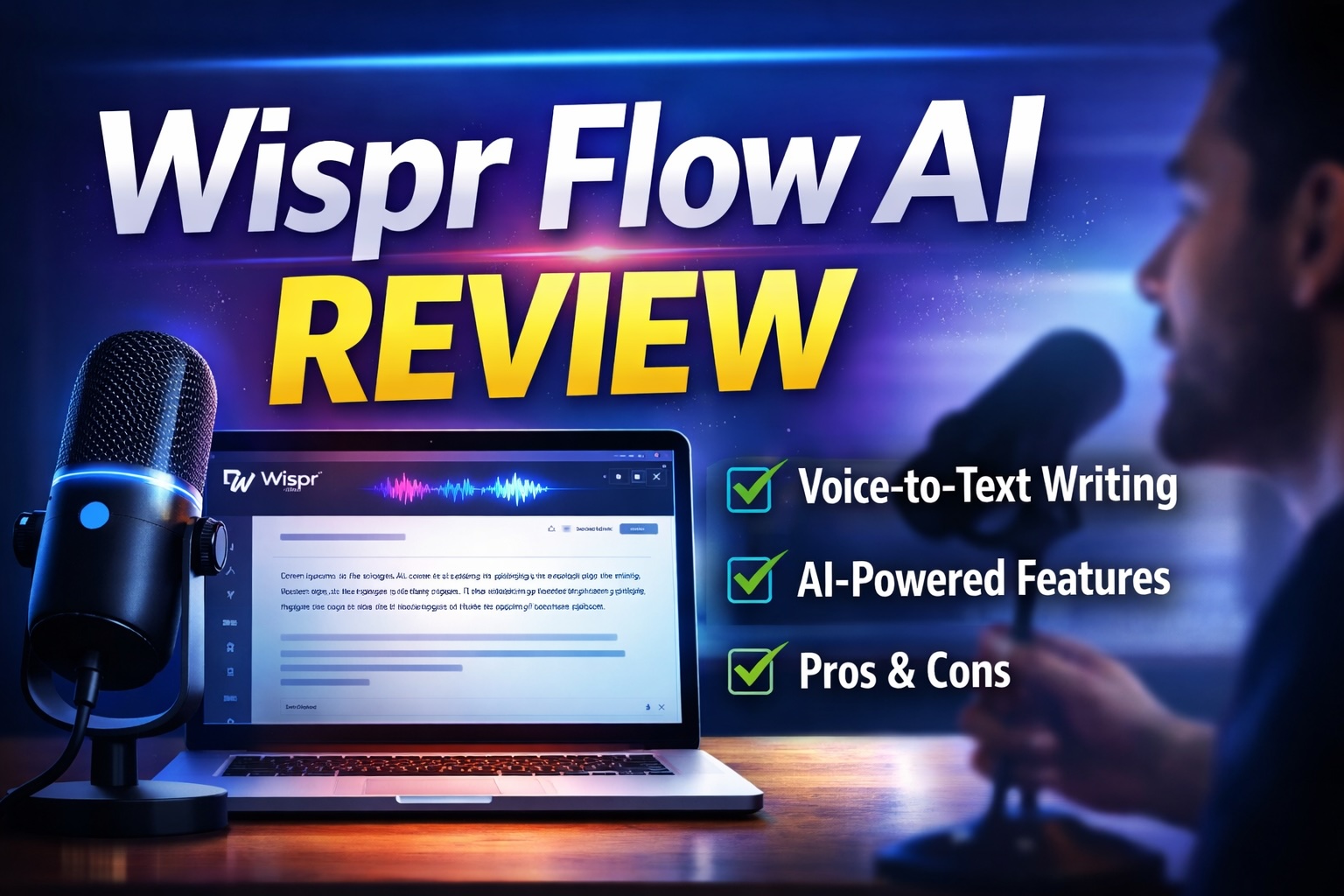
In this Wispr Flow AI review, I take a close look at what the tool actually delivers, where it fits in a modern workflow, and whether it is worth your time in 2026. Voice-driven productivity tools are evolving quickly, and Wispr Flow AI positions itself as a fast, frictionless way to write using speech rather than typing.
Wispr Flow AI is a voice-to-text productivity tool that uses AI to convert spoken language into structured, editable written content in real time. It focuses on improving writing speed and reducing friction by allowing users to dictate emails, documents, and notes naturally while maintaining formatting and clarity.
What Is Wispr Flow AI?
Wispr Flow AI is designed to replace traditional typing with voice-first writing. Instead of manually composing text, users speak naturally while the software converts speech into structured output that resembles typed content.
The core idea is not just transcription. Many speech-to-text tools already exist, but Wispr Flow AI aims to go further by formatting sentences, handling punctuation, and adapting to conversational tone without requiring constant correction.
This makes it particularly useful for professionals who write frequently, including marketers, founders, analysts, and anyone working with content-heavy tasks. The promise is simple. Speak your thoughts and let the system handle the structure.
That said, Wispr Flow AI is still part of a category that is evolving. Some features depend on accuracy and context understanding, which can vary depending on use case, language, and speaking style.
Wispr Flow AI review: Core Features
To understand whether Wispr Flow AI is worth using, you need to look beyond the idea of voice typing and focus on how the system behaves in real workflows.
Real-Time Voice-to-Text Conversion
The foundation of Wispr Flow AI is real-time speech recognition. You speak, and the system converts your words into text almost instantly. The responsiveness is one of the key advantages, especially compared to slower transcription tools.
In practice, this means you can draft emails, documents, or notes at the speed of speech. This is significantly faster than typing for most users.
Automatic Formatting and Structure
Unlike basic dictation tools, Wispr Flow AI attempts to structure your speech into readable text. It adds punctuation, organizes sentences, and aims to produce output that requires minimal editing.
This is one of its most important features. Without it, users would still need to spend time cleaning up raw transcripts.
Context-Aware Writing Flow
Wispr Flow AI is built to follow natural speech patterns rather than rigid command-based dictation. This allows users to speak freely without constantly thinking about formatting commands.
However, the level of context awareness may vary depending on complexity. For simple writing tasks, it performs well. For highly structured documents, some manual editing is still required.
Cross-App Compatibility
The tool is designed to work across different applications, allowing users to dictate directly into email clients, documents, and messaging platforms.
This reduces friction and removes the need to switch between tools. It is especially valuable for professionals who spend most of their day inside browsers or productivity apps.
Speed Optimization for Productivity
One of the main selling points is speed. Wispr Flow AI is optimized for rapid idea capture. Instead of slowing down to type, users can maintain their natural thinking pace while speaking.
This can lead to higher output volume, especially for tasks like drafting content, brainstorming, or writing internal communication.
Wispr Flow AI review: Use Cases
Wispr Flow AI is not a universal solution for every workflow, but it performs well in specific scenarios where speed and idea capture matter more than precision formatting.
Email Writing
One of the most practical uses is email drafting. Users can speak full emails quickly and let the system handle structure. This reduces time spent on repetitive communication.
Content Drafting
For blog posts, outlines, or social media content, Wispr Flow AI allows fast idea generation. It is particularly useful in early drafting stages where speed is more important than polish.
Note-Taking
Instead of typing notes during meetings or while thinking, users can speak and capture ideas instantly. This creates a more natural workflow, especially for those who think verbally.
Workflow Acceleration
Professionals who deal with high writing volume can benefit from reducing typing fatigue. Over time, this can significantly improve output efficiency.
However, for highly technical writing or structured reporting, traditional typing or editing tools may still be required.
Wispr Flow AI Pricing
At the time of writing, Wispr Flow AI pricing is not fully transparent on the official website, or it may vary depending on access model or early-stage rollout. This is not uncommon for newer tools in this category.
Some users may gain access through invite-based systems or limited beta programs. If you are evaluating Wispr Flow AI pricing, it is important to check the official site for the most up-to-date information.
In general, tools in this space often follow a subscription model with tiered usage limits. Without confirmed public pricing, it is difficult to compare directly with competitors on cost alone.
If pricing clarity is critical for your decision, this is one area where Wispr Flow AI may currently fall short compared to more established tools.
Pros and Cons
Pros
- Fast real-time voice-to-text conversion that improves writing speed
- Natural speech input without requiring strict dictation commands
- Automatic formatting reduces the need for heavy editing
- Works across different applications, improving workflow flexibility
- Strong potential for increasing productivity in content-heavy roles
Cons
- Pricing is not clearly defined or publicly transparent
- Accuracy may vary depending on speech clarity and context
- Not ideal for highly structured or technical writing tasks
- Still evolving compared to more mature competitors
Wispr Flow AI vs Competitors
To properly evaluate Wispr Flow AI, it helps to compare it with established tools in the same category.
Wispr Flow AI vs Otter.ai
Otter.ai focuses heavily on meeting transcription and collaboration. It is strong in capturing conversations and generating transcripts with speaker identification.
Wispr Flow AI, on the other hand, is more focused on personal productivity and writing. It is not designed primarily for meeting transcription but for replacing typing.
If your goal is meeting documentation, Otter.ai is likely a better fit. If your goal is faster writing, Wispr Flow AI has a clearer advantage.
Wispr Flow AI vs Dragon NaturallySpeaking
Dragon NaturallySpeaking has been a long-standing leader in dictation software. It offers high accuracy and advanced customization, especially for professional environments.
However, Dragon often requires more structured commands and setup. Wispr Flow AI aims for a more modern, fluid experience with less friction.
The trade-off is clear. Dragon offers precision and control, while Wispr Flow AI focuses on simplicity and speed.
Depending on your workflow, one approach may suit you better than the other.
FAQ
What is Wispr Flow AI used for?
Wispr Flow AI is used for voice-based writing. It allows users to dictate text instead of typing, making it useful for emails, content creation, and note-taking.
Is Wispr Flow AI accurate?
Accuracy depends on factors like speech clarity and context. For general writing tasks, it performs well, but complex or technical language may require editing.
How to use Wispr Flow AI?
You simply activate the tool and start speaking. The system converts your speech into text in real time. You can then edit or refine the output as needed.
Is Wispr Flow AI worth it?
It is worth considering if you want to increase writing speed and reduce typing. However, it may not replace traditional writing tools for all use cases.
What are the best Wispr Flow AI alternatives?
Popular alternatives include Otter.ai for transcription and Dragon NaturallySpeaking for advanced dictation. The best choice depends on your specific workflow needs.
Is Wispr Flow AI Worth It?
Wispr Flow AI is a promising tool for anyone looking to reduce typing and increase output speed. Its strength lies in simplicity and natural interaction.
That said, it is not a perfect replacement for traditional writing workflows. It works best as a productivity enhancer rather than a complete solution.
If your work involves a lot of drafting, brainstorming, or communication, it can provide meaningful efficiency gains.
If you require precise formatting or technical writing, you may still rely on manual editing or alternative tools.
Final Verdict
Wispr Flow AI is a strong addition to the voice-first productivity category. It focuses on speed, simplicity, and natural interaction, which makes it appealing for modern workflows.
While it is not without limitations, especially around pricing transparency and advanced formatting, it delivers clear value for users who prioritize efficiency.
Overall Rating: ★★★★☆ (4.0 / 5)
👉 Try Wispr Flow AI here and see if it fits your workflow