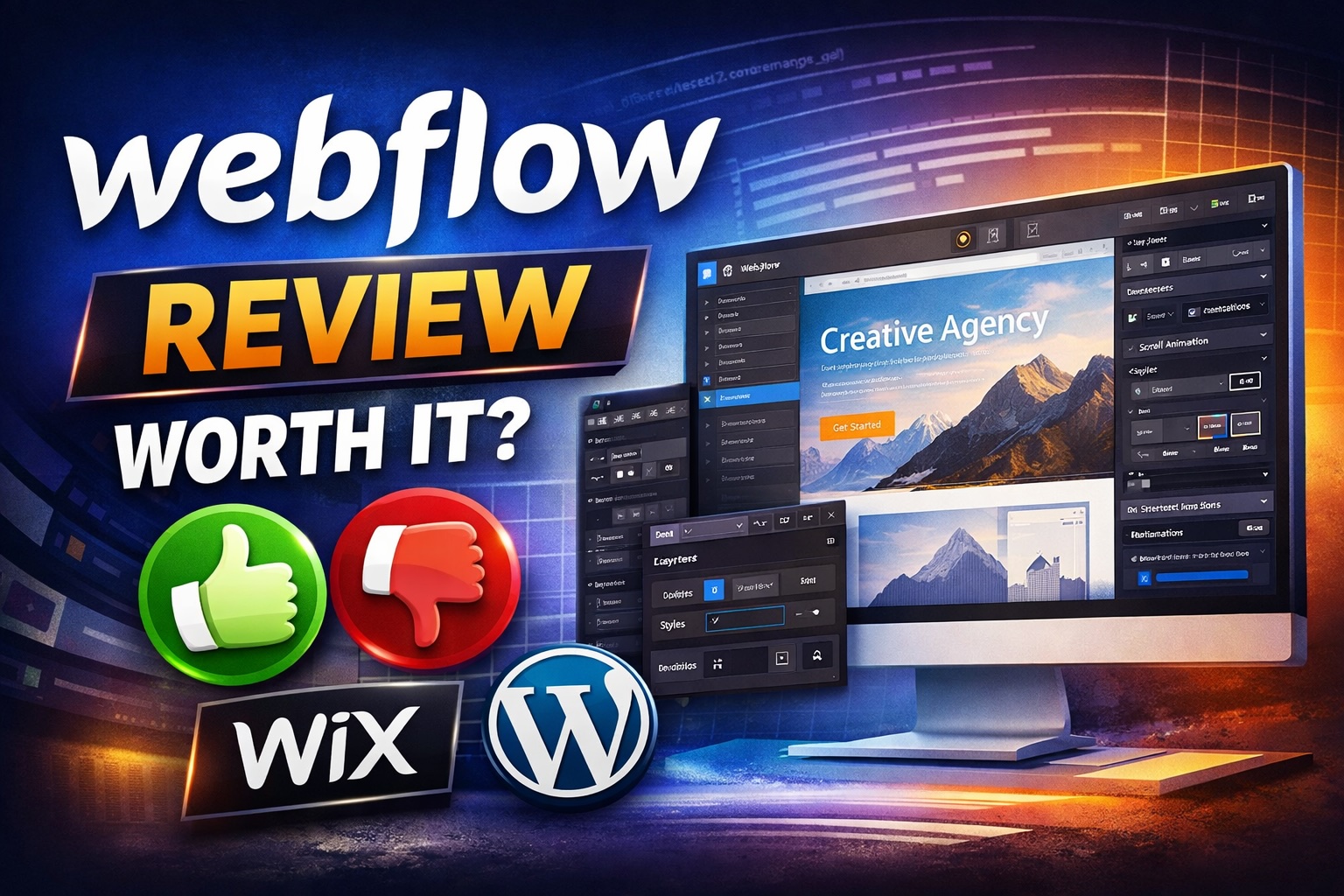
In this Webflow review, I take a close look at one of the most widely discussed no-code website builders on the market. Webflow sits somewhere between design freedom and developer-level control, which makes it appealing to both marketers and designers. But does it actually deliver in real workflows, and is Webflow worth it in 2026?
What is Webflow? Webflow is a visual website builder that combines design, CMS, and hosting into one platform, allowing users to build responsive websites without writing code while still offering advanced control over layout, animations, and structure.
What Is Webflow?
Webflow is a no-code website builder designed for users who want more control than traditional drag-and-drop tools provide. Instead of limiting users to rigid templates, it gives you a visual interface that mirrors HTML, CSS, and JavaScript logic.
At its core, Webflow combines three major elements. A design tool, a content management system, and hosting infrastructure. This means you can design, build, and publish a website without relying on external tools.
Unlike beginner-focused platforms, Webflow has a steeper learning curve. However, that trade-off is what allows it to produce highly customized and professional-grade websites.
If you are comparing Webflow alternatives, it is often positioned between tools like Wix and full developer stacks such as custom-coded React or WordPress builds.
Webflow review: Core Features
Understanding Webflow features is key to deciding whether it fits your workflow. The platform is built around flexibility, but that flexibility comes with complexity.
Visual Designer
The Webflow designer is its most powerful component. It allows you to visually manipulate layouts while controlling CSS properties like margin, padding, flexbox, and grid.
This is not a simple drag-and-drop editor. It requires some understanding of how web layouts work, but in return you gain near developer-level control.
CMS (Content Management System)
Webflow includes a built-in CMS that allows you to create dynamic content such as blogs, portfolios, and directories. You can define custom content structures and design layouts that automatically update.
This is particularly useful for SEO-driven websites where content scalability matters.
Hosting and Performance
Webflow hosts all websites on its own infrastructure. This includes CDN delivery, SSL certificates, and performance optimization. You do not need to manage servers or external hosting providers.
In most cases, performance is strong, although it depends on how efficiently your site is built.
Interactions and Animations
Webflow allows you to build advanced animations and interactions visually. This includes scroll-based animations, hover effects, and timed transitions.
For designers, this is one of the strongest advantages compared to simpler builders.
SEO Controls
Webflow provides full control over meta titles, descriptions, alt tags, and structured content. It also generates clean code, which is important for search engine indexing.
That said, advanced SEO setups still require external tools and strategy.
Webflow review: Use Cases
Webflow is not for everyone. Its value depends heavily on how you plan to use it.
- Marketing websites where design and performance matter
- Agency projects that require custom layouts without full development
- SEO content sites using the CMS for scalable publishing
- Startup landing pages that need flexibility and speed
- Portfolio websites with strong visual presentation
However, Webflow may not be ideal for complex web applications, advanced backend logic, or large-scale eCommerce compared to specialized platforms.
Webflow Pricing
Webflow pricing can be confusing because it separates site plans from workspace plans. This means you pay for both hosting and team collaboration depending on your setup.
Site plans typically include:
- Basic plan for simple websites
- CMS plan for content-driven sites
- Business plan for higher traffic and scalability
Workspace plans are designed for teams and freelancers who need multiple projects and collaboration features.
Pricing is not the cheapest compared to tools like Wix, but it reflects the flexibility and control Webflow offers. If you only need a basic website, it may feel expensive. If you need design precision, it becomes more justified.
If you are evaluating Webflow worth it from a pricing perspective, the key factor is whether you actually use its advanced capabilities.
Webflow Pros and Cons
Pros
- High level of design control compared to typical website builders
- Built-in CMS for dynamic content
- No need for external hosting or plugins
- Advanced animations and interactions
- Clean code output which supports SEO
Cons
- Steep learning curve for beginners
- Pricing structure can be confusing
- Limited backend functionality compared to full development stacks
- eCommerce features are not as mature as dedicated platforms
Overall, the Webflow pros and cons reflect a platform that prioritizes flexibility over simplicity.
Webflow vs Competitors
To properly evaluate Webflow alternatives, it is useful to compare it against major competitors like Wix and WordPress.
Webflow vs Wix
Wix is easier to use and better suited for beginners. It offers faster setup and simpler workflows. However, it lacks the same level of design precision and flexibility.
Webflow, on the other hand, gives you much more control but requires more effort to learn.
Webflow vs WordPress
WordPress is more powerful overall due to its plugin ecosystem and customization options. It is also more flexible for complex websites.
However, WordPress requires maintenance, hosting management, and technical setup. Webflow simplifies this by offering an all-in-one platform.
If your priority is ease of use with control, Webflow is a strong middle ground.
FAQ
Is Webflow good for beginners?
Webflow is not the easiest platform for beginners. It requires understanding of layout concepts like CSS and structure. However, once learned, it offers much more control than basic builders.
How to use Webflow effectively?
To use Webflow effectively, start by learning the fundamentals of layout systems like flexbox and grid. Following Webflow tutorials and templates can help shorten the learning curve.
Is Webflow good for SEO?
Yes, Webflow provides strong SEO controls including meta tags, clean code, and fast hosting. However, results still depend on your content strategy and optimization efforts.
Does Webflow replace developers?
Webflow can reduce the need for developers in many cases, especially for marketing sites. However, complex applications and backend logic still require development expertise.
What are the best Webflow alternatives?
Common Webflow alternatives include Wix for simplicity and WordPress for maximum flexibility. The best choice depends on your technical skill level and project requirements.
Is Webflow Worth It?
Webflow is worth it if you value design flexibility and want more control than traditional builders offer. It is particularly strong for agencies, designers, and marketers who need custom layouts.
However, if your priority is simplicity or low cost, other tools may be a better fit. The decision comes down to whether you are willing to invest time in learning the platform.
Final Verdict
Webflow is a powerful platform that bridges the gap between no-code tools and full development. It is not the easiest option, but it offers a level of control that few competitors match.
If you are serious about building high-quality websites without relying entirely on developers, Webflow is one of the strongest options available today.
Overall Rating: ★★★★☆ (4.5 / 5)
👉 Try Webflow here and see if it fits your workflow