Dext has become one of the better known bookkeeping automation tools for accountants, finance teams, and small businesses that want to reduce manual data entry. In this Dext review, we look at how the platform works, its strongest features, pricing structure, limitations, and whether it is actually worth adding to your accounting workflow in 2026.
Dext is a cloud based bookkeeping and expense management platform that helps businesses collect receipts, invoices, and financial documents, then automatically extract and organize the data for accounting software like Xero, QuickBooks, and Sage. It is mainly designed to reduce manual bookkeeping work and improve financial record accuracy.
What Is Dext?
Dext started as a receipt capture solution for accountants and has evolved into a broader bookkeeping automation platform. The software focuses on simplifying financial data collection, expense tracking, invoice processing, and document management.
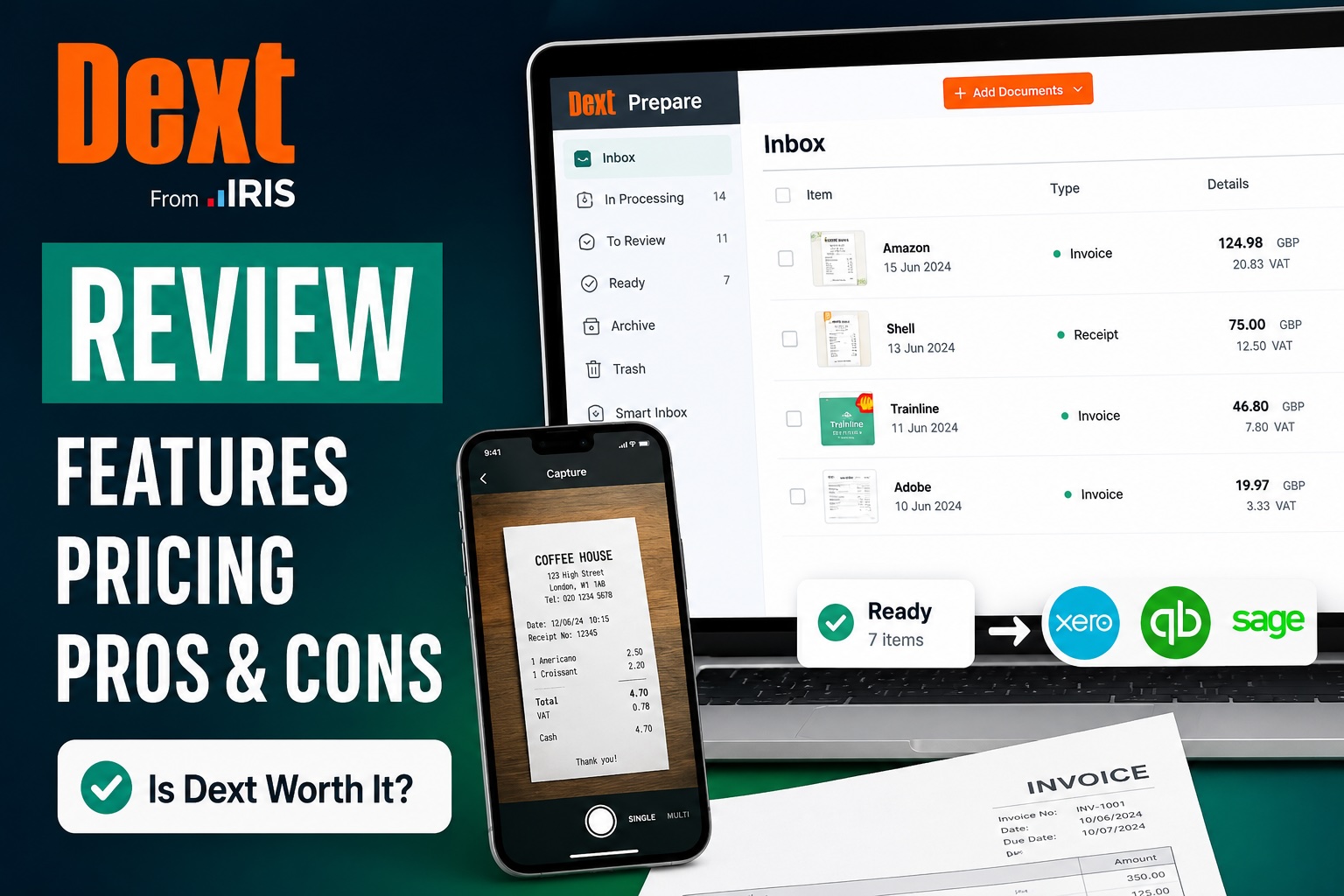
The platform works by allowing users to upload receipts, invoices, bills, and financial records through mobile apps, email forwarding, integrations, or desktop uploads. Dext then uses optical character recognition and automation tools to extract important information such as supplier names, totals, tax amounts, and transaction dates.
One reason Dext remains popular with accounting firms is its integration ecosystem. It connects directly with platforms like QuickBooks, Xero, and Sage, which helps reduce reconciliation work and manual entry.
The software is primarily aimed at:
- Small businesses
- Accounting firms
- Freelancers and consultants
- Bookkeepers
- Finance departments
- Businesses handling large invoice volumes
While Dext is not a complete accounting platform itself, it acts as a strong automation layer that sits between financial documents and accounting systems.
Dext review: Core Features
The biggest strength of Dext is not a single feature. It is the combination of document capture, bookkeeping automation, and accounting integrations working together in one workflow.
Receipt and Invoice Capture
Dext allows users to upload receipts and invoices in several ways:
- Mobile app scanning
- Email forwarding
- Desktop drag and drop
- Supplier integrations
- Automatic fetch from connected services
The mobile app is especially useful for businesses with employees on the move. Users can take a photo of a receipt and upload it directly into the system without needing to keep physical paperwork.
Automated Data Extraction
Dext automatically extracts data from uploaded financial documents. This includes:
- Supplier information
- Transaction dates
- Invoice numbers
- Tax details
- Currency values
- Total amounts
For businesses processing many invoices every month, this can significantly reduce repetitive bookkeeping tasks. Accuracy is generally strong for standard invoices and receipts, although more complex or poorly scanned documents may still require manual correction.
Accounting Software Integrations
Dext integrates with several major accounting systems, including:
- Xero
- QuickBooks Online
- Sage
- FreshBooks
- NetSuite
- KashFlow
This integration layer is one of the main reasons accountants adopt the software. Financial documents can move from Dext into accounting platforms without large amounts of manual handling.
Expense Management
Dext also includes expense management tools for employee spending. Businesses can centralize receipts, categorize transactions, and maintain better audit trails.
For companies with remote workers or teams traveling frequently, this feature helps organize reimbursement workflows and reduces lost receipts.
Bank Statement and Supplier Data Collection
Dext can automatically collect supplier invoices and bank related documents from connected sources. This reduces the need to manually request invoices from vendors or upload statements individually.
For accounting firms managing multiple clients, this automation can create noticeable efficiency gains over time.
Multi User Collaboration
The platform supports collaboration between accountants, finance teams, and business owners. Users can review, approve, and organize records inside a shared environment.
This is particularly valuable for bookkeeping firms managing many clients simultaneously.
Dext review: Use Cases
Dext is most effective when used in businesses that regularly process receipts, invoices, and bookkeeping records at scale.
Accounting Firms
Accounting firms are one of the strongest fits for Dext. The platform helps standardize document collection across clients while reducing manual bookkeeping hours.
Instead of chasing receipts through email chains, accountants can centralize everything inside Dext.
Small Businesses
Small businesses often struggle with keeping financial records organized. Dext simplifies this by giving owners a fast way to capture receipts and invoices without building complex processes.
Restaurants, retail businesses, agencies, consultants, and service companies are common examples.
Freelancers and Consultants
Freelancers can use Dext to maintain organized expense records for tax filing and bookkeeping purposes. The mobile capture feature makes it easy to log expenses immediately.
Finance Teams
Internal finance departments can use Dext to streamline invoice approvals and maintain cleaner financial documentation. Businesses with distributed teams may benefit from having a centralized expense system.
Businesses Operating Internationally
Dext supports multiple currencies and international document handling, making it useful for businesses working across different countries and suppliers.
However, businesses with highly specialized enterprise accounting requirements may still need more advanced ERP systems.
Dext Pricing
Dext pricing varies depending on the plan type, number of users, and document volume. The company offers separate products and pricing structures for businesses and accounting firms.
At the time of writing, Dext generally positions itself as a premium bookkeeping automation solution rather than a low cost receipt scanner.
The pricing structure typically includes:
- Entry level plans for smaller businesses
- Advanced plans with higher document limits
- Accounting practice focused packages
- Custom enterprise options
Businesses considering Dext should evaluate expected monthly document volume carefully because costs can increase as usage scales.
Compared with lightweight receipt scanners, Dext pricing may feel expensive for solo users. However, accounting firms and businesses handling large transaction volumes may still find the efficiency savings worthwhile.
Since pricing structures can change, it is best to verify current plans directly on the official Dext website before making a decision.
Dext Pros and Cons
Pros
- Strong integrations with major accounting platforms
- Reliable receipt and invoice capture system
- Useful automation for repetitive bookkeeping work
- Good mobile app experience for receipt uploads
- Helpful for accounting firms managing multiple clients
- Supports collaboration between finance teams and accountants
Cons
- Pricing may be high for freelancers or very small businesses
- Some document extraction still requires manual review
- Learning curve can exist for new users managing advanced workflows
- Not a full accounting platform on its own
The overall experience depends heavily on business size and accounting complexity. Companies processing large numbers of receipts and invoices will likely see much greater value than businesses with only occasional bookkeeping needs.
Dext vs Competitors
Dext operates in a competitive bookkeeping automation market. Some of the most common Dext alternatives include Hubdoc, Expensify, and AutoEntry.
Dext vs Hubdoc
Hubdoc is closely tied to the Xero ecosystem and is often included with certain Xero plans. This can make Hubdoc more cost effective for businesses already committed to Xero.
Dext generally offers broader bookkeeping automation workflows and more advanced practice management functionality for accounting firms. Businesses focused heavily on document management may prefer Dext despite the higher pricing.
Dext vs Expensify
Expensify focuses more heavily on employee expense management and reimbursements. It is commonly used for travel expenses and corporate spending controls.
Dext is generally stronger in bookkeeping automation and accountant focused workflows. Businesses mainly needing reimbursement management may lean toward Expensify instead.
Dext vs AutoEntry
AutoEntry is another bookkeeping automation platform that competes directly with Dext. It is often considered more affordable for smaller businesses.
Dext tends to offer a more polished user experience and broader ecosystem integrations, although the pricing difference can matter significantly for smaller organizations.
Ultimately, the best choice depends on workflow requirements, accounting software preferences, and budget constraints.
How to Use Dext
Getting started with Dext is relatively straightforward for most businesses.
- Create a Dext account and connect your accounting software
- Invite team members or accountants if needed
- Upload receipts and invoices through the mobile app or desktop
- Review extracted data for accuracy
- Publish approved transactions into your accounting platform
Most businesses can begin processing documents within a few hours. However, larger accounting firms may require additional setup to optimize workflows and client management structures.
The mobile application is one of the easier parts of the platform to adopt. Even non technical users can generally learn receipt uploads quickly.
FAQ
Is Dext worth it for small businesses?
Dext can be worth it for small businesses that process many receipts and invoices every month. The automation savings become more noticeable as transaction volume increases. Very small businesses with limited bookkeeping needs may find cheaper tools sufficient.
Does Dext work with QuickBooks?
Yes. Dext integrates with QuickBooks Online along with several other accounting platforms including Xero and Sage. These integrations are one of the platform’s strongest selling points.
Can Dext replace an accountant?
No. Dext automates document collection and bookkeeping tasks, but it does not replace professional accounting advice or financial oversight. It is best viewed as a productivity tool for finance workflows.
Is Dext accurate?
Dext is generally accurate for standard invoices and receipts. However, some uploaded documents may still require manual review, especially if scans are unclear or formatting is unusual.
What are the best Dext alternatives?
Some of the most common Dext alternatives include Hubdoc, Expensify, and AutoEntry. The best option depends on whether you prioritize bookkeeping automation, expense management, integrations, or pricing.
Is Dext Worth It?
For accounting firms and businesses dealing with high document volumes, Dext can provide real operational efficiency improvements. Automating repetitive bookkeeping tasks may reduce administrative workload and improve record organization.
The platform is especially strong when paired with established accounting systems like QuickBooks or Xero. The workflow integration is where much of the practical value comes from.
However, businesses with very limited bookkeeping requirements may not fully justify the subscription cost. In those cases, simpler or lower cost alternatives could be sufficient.
Overall, Dext is best suited for users who regularly process invoices, receipts, and supplier documentation at scale rather than occasional bookkeeping users.
Final Verdict
Dext remains one of the stronger bookkeeping automation platforms available in 2026. Its combination of receipt capture, invoice processing, accounting integrations, and workflow automation makes it particularly useful for accountants and growing businesses.
The software is not the cheapest option in the category, but the productivity gains may justify the cost for organizations handling significant bookkeeping workloads.
Businesses looking for deep accounting automation rather than just simple expense tracking will likely find more value in Dext than lighter competitors.
Overall Rating: ★★★★☆ (4.5 / 5)
👉 Try Dext here and see if it fits your workflow