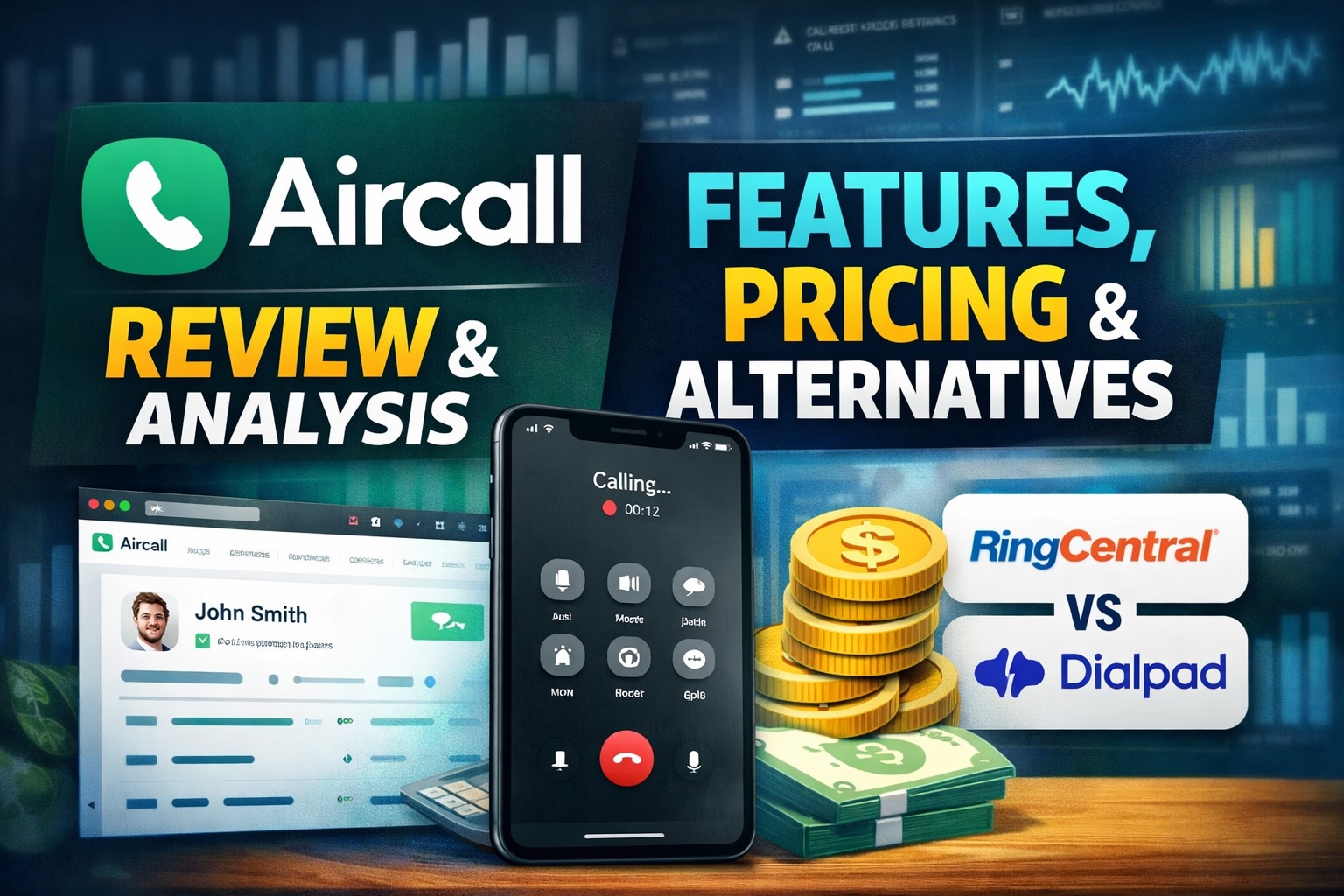
In this Aircall review, I take a close, practical look at one of the most widely used cloud-based phone systems for modern teams. Whether you run sales, support, or operations, Aircall positions itself as a flexible and integration-heavy communication platform. The question is simple: does it actually deliver value in real workflows, or is it just another VoIP tool with good branding?
Aircall is a cloud-based business phone system designed for sales and support teams. It enables companies to make and receive calls over the internet, manage call flows, and integrate communication directly into tools like CRMs and help desks, without relying on traditional telecom infrastructure.
What Is Aircall?
Aircall is a VoIP platform built specifically for business communication. Instead of using physical phone systems, it operates entirely in the cloud, allowing teams to manage calls from desktop or mobile apps. It is particularly focused on customer-facing teams such as sales and support, where call tracking, collaboration, and integrations are critical.
The platform is known for its ability to plug directly into tools like Salesforce, HubSpot, and Zendesk. This means calls, notes, and customer data are synced automatically, reducing manual work and improving visibility across teams.
For companies scaling their operations or working remotely, Aircall replaces traditional phone systems with something far more flexible and easier to manage.
Aircall review: Core Features
The core strength of Aircall lies in how it combines telephony with workflow automation and integrations. Below are the most relevant features based on actual usage scenarios.
Cloud-Based Calling
Aircall allows you to make and receive calls from anywhere using internet connectivity. There is no need for hardware installation, which makes setup relatively quick. Teams can operate from different locations without losing access to a centralized phone system.
Call Routing and IVR
You can design custom call flows using interactive voice response and routing rules. This ensures calls are directed to the right person or department based on availability, time, or caller input. For support teams, this is essential to maintain efficiency and reduce wait times.
CRM and Helpdesk Integrations
Aircall integrates with major platforms like HubSpot, Salesforce, and Zendesk. Calls are automatically logged, and customer profiles are updated in real time. This reduces administrative work and ensures that every interaction is tracked properly.
Call Monitoring and Analytics
Managers can monitor calls live, listen to recordings, and analyze performance metrics. This includes call duration, response time, and agent activity. It is particularly useful for training and quality assurance in support teams.
Collaboration Tools
Aircall includes features like shared call inboxes, internal comments, and call tagging. These tools allow teams to collaborate on customer interactions without switching platforms.
Power Dialer
For sales teams, the power dialer helps automate outbound calling. It reduces manual dialing and allows reps to move through call lists more efficiently. This is one of the key features for high-volume outbound operations.
Aircall review: Use Cases
Aircall is not designed for every type of business. Its value becomes clear in specific use cases where communication is central to operations.
- Customer support teams: Manage inbound calls, track interactions, and improve response times.
- Sales teams: Use the power dialer and CRM integrations to increase outbound efficiency.
- Remote teams: Operate a unified phone system without physical infrastructure.
- Scaling startups: Quickly add numbers, users, and workflows without complex setup.
If your workflow relies heavily on calls and CRM data, Aircall fits naturally. If not, it may feel like overkill.
Aircall Pricing
Aircall pricing is structured as a subscription model per user, per month. While exact pricing can change, the general tiers are as follows:
- Essentials plan: Basic calling features, integrations, and support
- Professional plan: Advanced analytics, power dialer, and more integrations
- Custom enterprise plans: Tailored solutions for larger teams
It is important to note that Aircall is not the cheapest option in the VoIP space. It positions itself as a premium solution with strong integrations. For small teams with simple needs, the cost may be difficult to justify.
If you are evaluating Aircall pricing, the real consideration is not just cost, but how much time and efficiency it saves across your team.
Aircall Pros and Cons
No tool is perfect, and Aircall is no exception. Here is a balanced breakdown based on real usage.
Pros
- Strong integrations with CRM and support platforms
- Easy to set up without hardware requirements
- Excellent call routing and workflow customization
- Built-in analytics and call monitoring tools
- Scales well for growing teams
Cons
- Pricing can be high compared to alternatives
- Some advanced features are locked behind higher tiers
- Not ideal for businesses that do not rely heavily on calls
The overall experience is solid, but the cost-to-value ratio depends heavily on how central calling is to your operations.
Aircall vs Competitors
To properly evaluate whether Aircall is worth it, it needs to be compared with alternatives like RingCentral and Dialpad.
Aircall vs RingCentral
RingCentral is a more traditional unified communications platform. It offers messaging, video, and phone in one system. Aircall, on the other hand, focuses primarily on calling and integrations.
If you need an all-in-one communication suite, RingCentral may be the better option. If your priority is sales or support workflows tied to CRM systems, Aircall is more focused.
Aircall vs Dialpad
Dialpad emphasizes AI features such as real-time transcription and voice intelligence. Aircall offers some analytics, but it is not as AI-driven.
Dialpad may be a better choice if AI insights are a priority. Aircall is stronger when it comes to integrations and workflow customization.
In short, Aircall sits in a middle position. It is not the cheapest, and not the most AI-driven, but it is highly practical for teams that rely on structured call workflows.
FAQ
What is Aircall used for?
Aircall is used as a business phone system for managing inbound and outbound calls. It is commonly used by sales and support teams to track conversations, route calls, and integrate communication into CRM systems.
Is Aircall worth it for small businesses?
It depends on your needs. If your business relies heavily on calls and customer interaction, Aircall can provide strong value. If your communication is mostly email or chat-based, it may be more than you need.
How to use Aircall?
After setting up an account, you can configure phone numbers, create call flows, and connect integrations. Most users operate Aircall through its desktop or mobile app, making and receiving calls directly from there.
Does Aircall integrate with CRM tools?
Yes, Aircall integrates with major CRM and support platforms like HubSpot, Salesforce, and Zendesk. These integrations are one of its main strengths.
What are the best Aircall alternatives?
Popular alternatives include RingCentral, Dialpad, and other VoIP providers. The best option depends on whether you prioritize cost, AI features, or integrations.
Is Aircall Worth It?
Aircall is worth it if your business depends on structured communication workflows. The platform excels in integrating calls with CRM systems and enabling collaboration across teams.
However, if your needs are basic or budget-sensitive, there are cheaper alternatives that may cover the essentials. Aircall is best viewed as a productivity tool for communication-heavy teams rather than a simple phone system.
Final Verdict
Aircall delivers a reliable and well-integrated cloud phone system tailored for modern teams. It does not try to be everything, but what it does, it does well. The biggest consideration is pricing, which may limit accessibility for smaller businesses.
Overall Rating: ★★★★☆ (4.2 / 5)
👉 Try Aircall here and see if it fits your workflow