If you’re evaluating call tracking and analytics tools, this CallRail review will give you a clear, grounded understanding of what the platform actually does and where it fits. CallRail has become a popular option for marketers who want to connect inbound calls to campaigns without relying on guesswork.
What is CallRail? CallRail is a call tracking and marketing analytics platform that helps businesses attribute phone calls, form submissions, and text messages to specific campaigns, keywords, or channels. It is primarily used by agencies and marketing teams to measure ROI and improve lead generation performance.
What Is CallRail?
CallRail is designed to solve a very specific problem: tracking offline conversions. While most analytics tools focus on clicks and form fills, CallRail focuses on what happens when a lead picks up the phone.
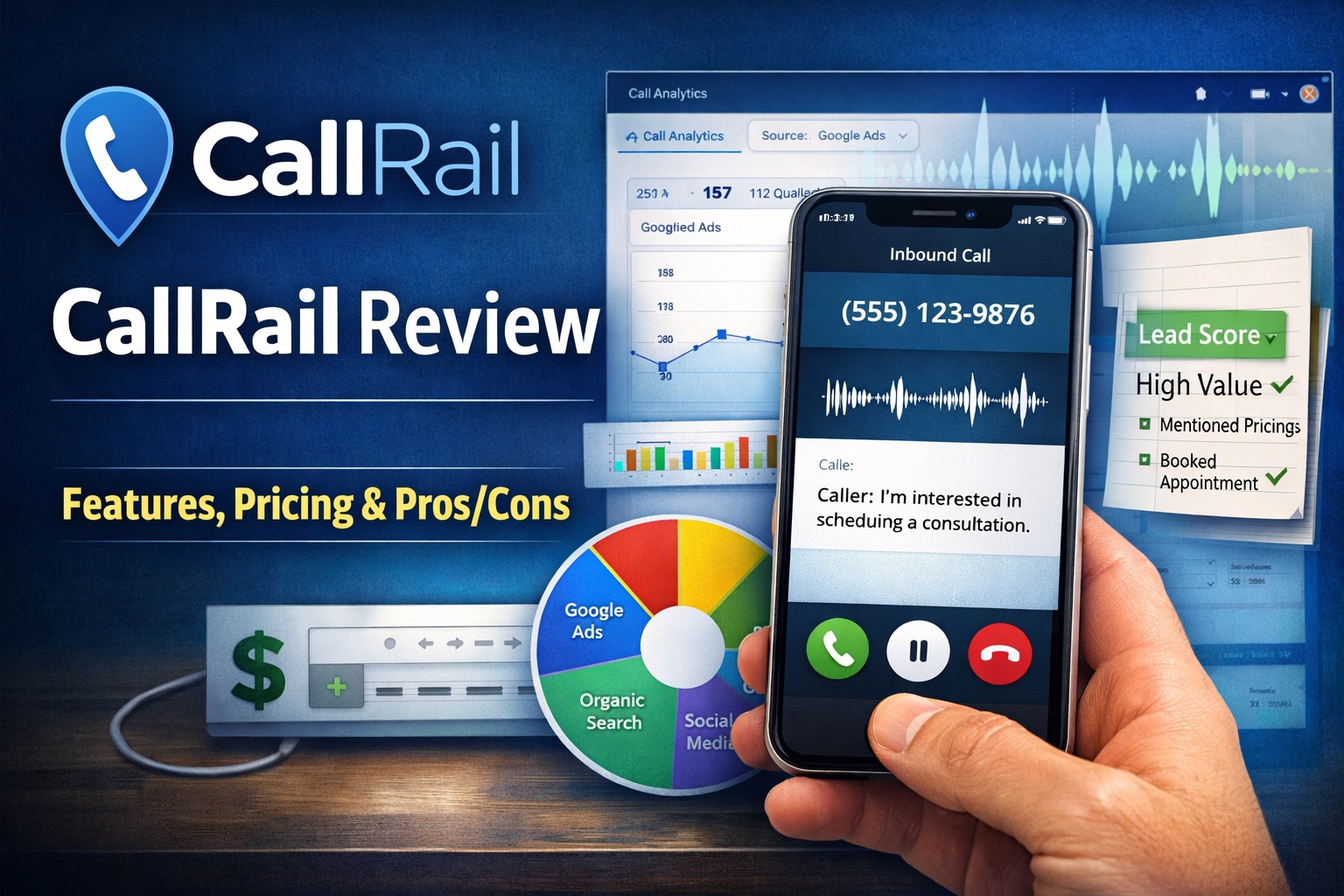
The platform assigns dynamic phone numbers to different marketing sources such as Google Ads, organic search, or social media. When someone calls, CallRail records the source, captures call data, and can even transcribe the conversation.
Beyond call tracking, it has expanded into form tracking, conversation intelligence, and basic automation features. The result is a more complete picture of how your marketing efforts convert into actual leads.
CallRail review: Core Features
CallRail’s value comes from a combination of tracking, attribution, and insight. Here are the key features that matter most in practice.
Call Tracking
This is the foundation of the platform. CallRail uses dynamic number insertion to assign unique phone numbers to different visitors based on their source. That means you can track whether a call came from Google Ads, SEO, or a specific campaign.
The tracking is generally reliable, though accuracy depends on proper setup and number pool size.
Conversation Intelligence
CallRail includes AI-powered call transcription and keyword spotting. This allows you to search conversations, identify lead quality, and detect intent signals such as pricing questions or booking requests.
While not as advanced as dedicated speech analytics tools, it provides enough insight for most marketing teams.
Form Tracking
In addition to calls, CallRail tracks form submissions and connects them to traffic sources. This helps unify online and offline conversion tracking in one place.
Text Messaging
You can send and receive SMS messages through tracked numbers. This is useful for businesses that rely on quick follow-ups or appointment confirmations.
Integrations
CallRail integrates with tools like Google Analytics, Google Ads, HubSpot, and Salesforce. These integrations allow you to push call data into your broader marketing and CRM systems.
Integration setup is straightforward, though some configurations require technical familiarity.
CallRail review: Use Cases
CallRail is not a general-purpose marketing tool. It is best suited for specific scenarios where phone calls matter.
- Marketing agencies tracking ROI for multiple clients
- Local service businesses such as dentists, law firms, and contractors
- PPC specialists who need to attribute calls to campaigns
- Sales teams looking to analyze inbound call quality
If your business relies heavily on inbound calls, CallRail can provide clarity that standard analytics tools cannot.
However, if your conversions are primarily online and form-based, the value becomes more limited.
CallRail Pricing
CallRail pricing is subscription-based and depends on usage, especially the number of tracking numbers and call volume.
Plans typically include:
- Basic call tracking plans starting at a relatively low monthly cost
- Advanced plans with conversation intelligence and automation features
- Additional costs for call minutes, phone numbers, and add-ons
One important detail is that pricing can scale quickly as your usage grows. Agencies managing multiple clients should pay close attention to number pools and call volume to avoid unexpected costs.
Compared to alternatives, CallRail sits in the mid-range. It is not the cheapest option, but it offers a balanced feature set.
CallRail Pros and Cons
Pros
- Reliable call tracking with clear attribution
- Easy-to-use interface for non-technical users
- Strong integrations with major marketing platforms
- Useful call transcription and keyword insights
- Good fit for agencies managing multiple clients
Cons
- Costs can increase quickly with higher usage
- Conversation intelligence is useful but not industry-leading
- Requires careful setup for accurate tracking
The pros and cons of CallRail are relatively straightforward. It performs its core function well, but it is not a full marketing platform.
CallRail vs Competitors
To understand whether CallRail is worth it, it helps to compare it with a few well-known alternatives.
CallRail vs WhatConverts
WhatConverts focuses on lead tracking across calls, forms, and chats. It offers a more unified lead management experience compared to CallRail.
CallRail, however, has a more polished interface and better call analytics. If your priority is call tracking specifically, CallRail is usually the better choice.
CallRail vs Invoca
Invoca is a more enterprise-focused solution with advanced AI and attribution capabilities. It is significantly more powerful but also more expensive and complex.
CallRail sits in a more accessible position. It offers enough functionality for most businesses without the complexity of enterprise tools.
If you are a large organization with complex attribution needs, Invoca may be worth exploring. For most small to mid-sized teams, CallRail is more practical.
FAQ
How does CallRail work?
CallRail assigns unique phone numbers to different traffic sources. When someone calls, the platform tracks where they came from and records the interaction. This data is then available in reports and integrations.
Is CallRail worth it for small businesses?
Yes, especially for businesses that rely heavily on phone calls. It can provide clear insights into which marketing efforts are driving leads. However, businesses with low call volume may not see enough value.
Does CallRail offer AI features?
CallRail includes basic AI features such as call transcription and keyword detection. These are useful for identifying trends but are not as advanced as dedicated AI analytics platforms.
How to use CallRail effectively?
To get the most value, you need proper setup. This includes configuring number pools, integrating with analytics tools, and defining conversion goals. Without this, tracking accuracy may be limited.
What are the best CallRail alternatives?
Popular alternatives include WhatConverts for broader lead tracking and Invoca for enterprise-level analytics. The best choice depends on your budget and complexity needs.
Is CallRail Worth It?
If your business depends on inbound calls, CallRail is a strong and practical solution. It provides clear attribution, useful insights, and integrates well with common marketing tools.
However, it is not a complete marketing platform. It works best as part of a broader stack rather than a standalone solution.
In simple terms, CallRail is worth it if calls are a key conversion channel. If not, the value is more limited.
Final Verdict
CallRail does exactly what it promises. It helps you understand where your calls come from and what happens during those conversations. It does not try to be everything, which is part of its strength.
There are limitations, particularly around pricing scalability and advanced AI capabilities. Still, for most marketing teams, it offers a reliable and efficient way to track real-world conversions.
Overall Rating: ★★★★☆ (4.3 / 5)
👉 Try CallRail here and see if it fits your workflow