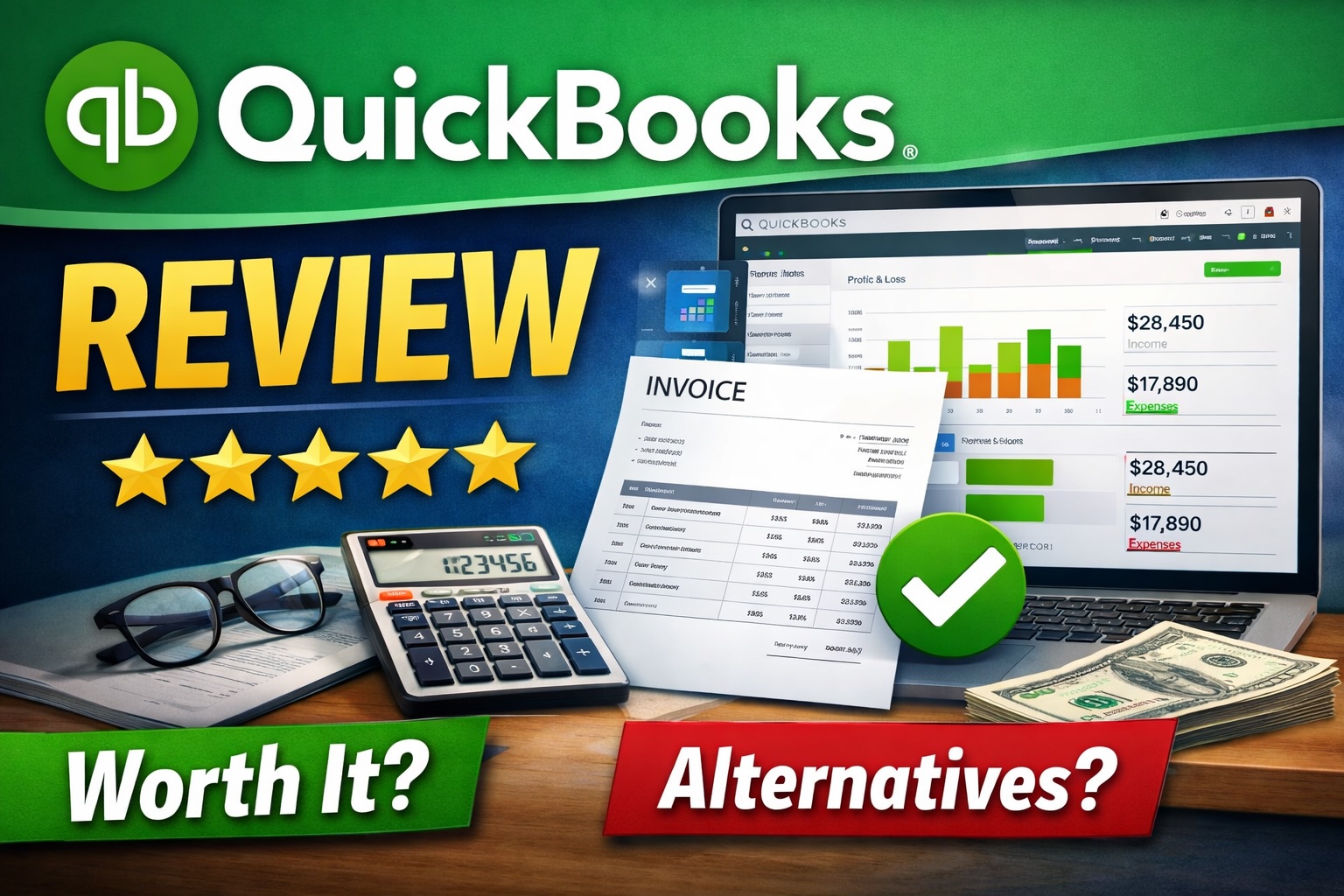
In this QuickBooks review, I take a close, practical look at one of the most widely used accounting platforms for small and medium sized businesses. Whether you are managing invoices, tracking expenses, or preparing for tax season, QuickBooks is often one of the first tools that comes up. The real question is whether it still holds up in 2026.
QuickBooks is a cloud-based accounting software designed to help businesses manage bookkeeping, invoicing, expenses, payroll, and financial reporting in one place. It simplifies financial management for small to mid-sized companies by automating tasks and providing real-time insights into business performance.
What Is QuickBooks?
QuickBooks, developed by Intuit, is a comprehensive accounting platform aimed primarily at small businesses, freelancers, and growing companies. It exists in several versions, but the most widely used today is QuickBooks Online, which runs entirely in the cloud.
The platform focuses on simplifying financial workflows that would otherwise require manual spreadsheets or separate tools. This includes invoicing clients, reconciling bank transactions, tracking expenses, generating reports, and handling taxes.
One of its biggest advantages is its ecosystem. QuickBooks integrates with hundreds of third-party tools, including payment processors, CRM systems, and payroll services. For many businesses, it becomes the financial backbone of operations.
However, it is not designed for every scenario. Larger enterprises or highly complex accounting structures may find it limiting compared to more advanced ERP systems.
QuickBooks review: Core Features
QuickBooks offers a broad feature set, but its real value comes from how these features work together. Below are the core capabilities that define the platform.
1. Invoicing and Payments
You can create professional invoices, send them directly to clients, and track payment status in real time. The system also supports online payments, allowing customers to pay via credit card or bank transfer.
Recurring invoices are particularly useful for subscription-based businesses, reducing repetitive manual work.
2. Expense Tracking
QuickBooks automatically imports transactions from connected bank accounts and credit cards. Expenses can be categorized and matched to receipts, making bookkeeping more efficient and audit-ready.
This automation reduces errors and ensures that financial records remain accurate over time.
3. Financial Reporting
The platform provides a wide range of reports, including profit and loss statements, balance sheets, and cash flow reports. These can be customized to suit different reporting needs.
For decision-making, this is one of the strongest areas of QuickBooks. Reports are clear, structured, and accessible even to non-accountants.
4. Tax Preparation and Compliance
QuickBooks helps organize financial data for tax filing, including VAT or sales tax tracking depending on your region. It can also integrate with tax software or accountants.
While it simplifies preparation, businesses with complex tax structures may still require professional accounting support.
5. Payroll and Employee Management
Payroll functionality is available as an add-on. It allows businesses to manage salaries, deductions, and tax filings. This turns QuickBooks into a more complete financial system.
However, payroll availability and features vary by country.
6. Integrations and Ecosystem
QuickBooks integrates with tools like Shopify, PayPal, Stripe, and many CRM systems. This makes it easier to centralize financial data across your business.
This ecosystem is one of the main reasons QuickBooks remains competitive.
QuickBooks review: Use Cases
QuickBooks is versatile, but it is especially well suited for certain types of users.
- Small business owners who need a reliable accounting system without hiring a full-time accountant
- Freelancers and consultants managing invoices and expenses independently
- Ecommerce businesses integrating sales and payment data into one dashboard
- Startups that need structured financial reporting for investors
It is less ideal for large corporations with complex multi-entity structures, where more advanced ERP solutions may be required.
QuickBooks Pricing
QuickBooks pricing is structured across multiple tiers, typically based on features and number of users. Pricing varies slightly by region, but the general structure includes:
- Simple Start for basic bookkeeping and invoicing
- Essentials adding bill management and multiple users
- Plus including inventory tracking and project profitability
- Advanced with enhanced reporting and automation
Additional costs may apply for payroll, payments, and certain integrations.
Compared to competitors, QuickBooks sits in the mid to higher price range, but it justifies this with its feature depth and ecosystem.
If you are just starting out, the lower tiers are usually sufficient. As your business grows, upgrading becomes necessary to unlock more advanced functionality.
QuickBooks Pros and Cons
Pros
- Comprehensive feature set covering most accounting needs
- Strong reporting capabilities for financial analysis
- Large integration ecosystem with third-party tools
- Widely adopted, making it easy to find accountants familiar with it
- Cloud-based access with real-time updates
Cons
- Pricing can become expensive as you scale
- Interface can feel complex for beginners
- Some features require additional paid add-ons
- Limited customization compared to enterprise systems
Overall, the pros outweigh the cons for most small to mid-sized businesses, but cost and complexity are worth considering.
QuickBooks vs Competitors
QuickBooks competes with several accounting tools, but two of the most notable alternatives are Xero and FreshBooks.
QuickBooks vs Xero
Xero is often seen as the closest competitor. It offers a cleaner interface and strong international support. However, QuickBooks generally provides more advanced reporting and a larger ecosystem of integrations.
If usability is your priority, Xero may feel more intuitive. If depth and scalability matter more, QuickBooks has the edge.
QuickBooks vs FreshBooks
FreshBooks is designed more for freelancers and service-based businesses. It excels in invoicing and time tracking but lacks the full accounting depth of QuickBooks.
QuickBooks is the better choice for businesses that need full financial management, while FreshBooks is ideal for simpler use cases.
There are also other alternatives like Zoho Books, which can be more affordable but may not match QuickBooks in ecosystem maturity.
FAQ
Is QuickBooks good for beginners?
QuickBooks can be used by beginners, but there is a learning curve. The interface is not overly complex, but understanding accounting basics will help you get the most out of the platform.
Is QuickBooks worth it for small businesses?
For most small businesses, QuickBooks is worth it due to its comprehensive features and reliability. It centralizes financial management, which saves time and reduces errors.
Can QuickBooks replace an accountant?
QuickBooks can automate many accounting tasks, but it does not fully replace an accountant. For tax planning, compliance, and complex financial decisions, professional advice is still recommended.
How to use QuickBooks effectively?
To use QuickBooks effectively, connect your bank accounts, categorize transactions regularly, and review reports monthly. Consistency is key to maintaining accurate financial records.
What are the best QuickBooks alternatives?
The best alternatives include Xero, FreshBooks, and Zoho Books. Each offers different strengths depending on your business size and complexity.
Is QuickBooks Worth It?
QuickBooks is worth it for businesses that need a reliable, scalable accounting system with strong reporting and integrations. It is not the cheapest option, but it offers a level of functionality that many competitors struggle to match.
If your goal is to move beyond spreadsheets and build a structured financial system, QuickBooks is a solid investment. However, if your needs are minimal, a simpler or cheaper tool may be sufficient.
Final Verdict
QuickBooks remains one of the most established accounting tools on the market. Its strength lies in its balance between usability and depth. While it is not perfect, especially in terms of pricing and simplicity, it delivers where it matters most.
Overall Rating: ★★★★☆ (4.5 / 5)
👉 Try QuickBooks here and see if it fits your workflow