In this Reply.io review, I take a close, practical look at what this sales engagement platform actually delivers in 2026. If you are running outbound campaigns, managing SDR workflows, or scaling cold outreach, understanding whether Reply.io fits your workflow is essential before committing time and budget.
Reply.io is a sales engagement platform that helps teams automate outreach across email, LinkedIn, calls, and other channels while using AI to personalize communication at scale. It is designed for SDR teams, founders, and agencies who want structured outbound pipelines without manually managing every step.
What Is Reply.io?
Reply.io is a multi channel outbound platform focused on helping sales teams run structured and scalable outreach campaigns. At its core, it combines email automation, CRM integrations, prospecting tools, and AI powered personalization into one system.
The platform is built primarily for outbound sales workflows. This includes cold email sequences, LinkedIn touches, follow ups, and tracking engagement across prospects. Instead of juggling multiple tools, Reply.io aims to centralize everything into one interface.
What differentiates Reply.io from simpler tools is its focus on full sales engagement rather than just email automation. It sits somewhere between lightweight cold email tools and more enterprise level systems.
If you are familiar with tools like Outreach or Salesloft, Reply.io positions itself as a more accessible and flexible alternative, especially for smaller teams and growing businesses.
Reply.io review: Core Features
Reply.io offers a wide set of features aimed at covering the entire outbound process. Below are the most relevant ones based on actual usage and documentation.
Multichannel Sequences
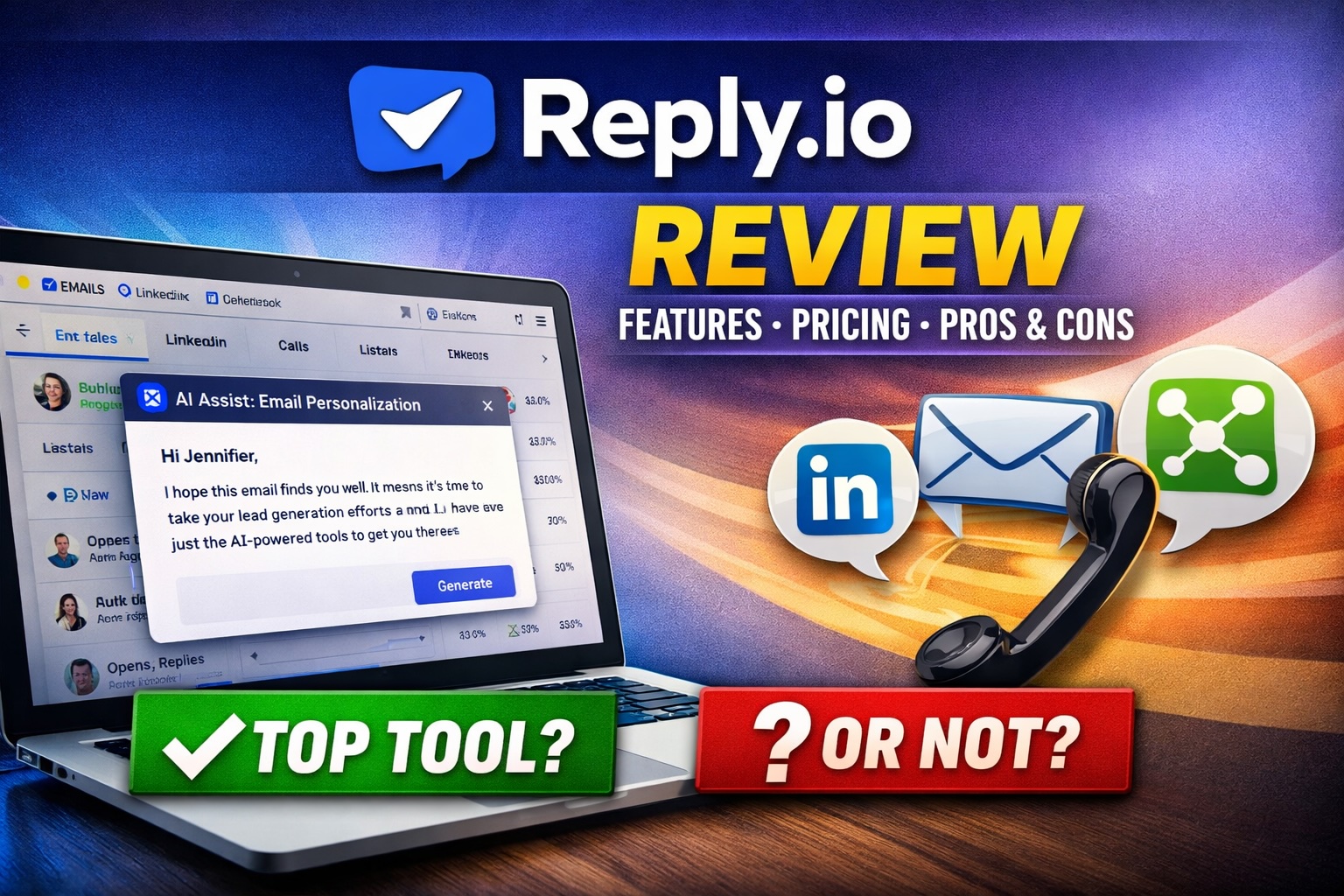
One of the strongest features is the ability to build multichannel sequences. Instead of relying only on email, you can combine emails, LinkedIn messages, connection requests, calls, and tasks into one unified flow.
This creates a more natural outreach experience and improves response rates compared to email only campaigns.
AI Personalization
Reply.io has integrated AI tools to help generate personalized messages at scale. This includes writing email drafts, suggesting improvements, and tailoring messages based on prospect data.
While useful, the output still requires review. It speeds up workflows but should not be used blindly.
Email Automation and Deliverability Tools
Email automation remains a core pillar. You can create sequences with delays, conditions, and triggers. Reply.io also includes deliverability features such as warm up tools and sending optimization.
This is critical if you are sending high volumes of cold emails and want to avoid spam filters.
Built In Prospecting
Reply.io includes access to a B2B contact database, allowing users to find leads directly within the platform. This reduces the need for separate tools for sourcing contacts.
That said, data accuracy can vary, so it is often combined with external validation tools.
CRM Integrations
The platform integrates with popular CRMs such as HubSpot and Salesforce. This allows you to sync contacts, track activities, and keep your pipeline updated without manual input.
For teams already using a CRM, this is a key requirement rather than a bonus feature.
Analytics and Reporting
Reply.io provides dashboards showing open rates, reply rates, and overall campaign performance. These insights help refine messaging and sequence structure over time.
While not as advanced as enterprise tools, the reporting is sufficient for most outbound teams.
Reply.io review: Use Cases
Reply.io is not a general purpose tool. It is built specifically for outbound and sales engagement. Here are the main use cases where it performs well.
- Outbound sales teams: SDRs and BDRs can automate outreach while maintaining personalization.
- Lead generation agencies: Agencies managing multiple clients can run campaigns at scale.
- Startup founders: Early stage founders can build outbound pipelines without hiring a full sales team.
- Recruitment outreach: Recruiters can contact candidates across channels using structured sequences.
- Partnership and business development: Teams can use it for outreach to potential partners and collaborators.
It is less suitable for inbound marketing or content driven funnels. This is clearly an outbound focused system.
Reply.io Pricing
Reply.io pricing depends on the features and scale required. Plans typically vary based on user seats, access to multichannel features, and data tools.
At a general level:
- Entry level plans focus on email automation and basic sequences
- Mid tier plans include multichannel outreach and integrations
- Higher tier plans add advanced features like AI tools and expanded data access
Pricing is not always fully transparent without contacting sales, especially for larger teams. If accurate pricing is critical, it is best to check directly on their official site.
Compared to competitors, Reply.io usually sits in the mid range. It is more expensive than basic cold email tools but more affordable than enterprise platforms.
Reply.io Pros and Cons
Pros
- Strong multichannel capabilities combining email, LinkedIn, and calls
- AI features help speed up personalization and content creation
- Built in prospecting reduces need for additional tools
- Good balance between usability and advanced functionality
- Integrates well with major CRMs like HubSpot and Salesforce
Cons
- Pricing can be unclear and higher than simple alternatives
- Learning curve for new users due to feature depth
- AI outputs still require manual review for quality
- Contact data accuracy is not always consistent
Overall, the strengths clearly outweigh the limitations, but the tool requires proper setup to unlock its full value.
Reply.io vs Competitors
To understand whether Reply.io is worth it, it helps to compare it against a few well known alternatives.
Reply.io vs Lemlist
Lemlist focuses heavily on email personalization and visual customization. It is often simpler and more focused on email campaigns.
Reply.io offers broader multichannel capabilities, making it more suitable for teams that want to combine email, LinkedIn, and calls in one system.
If your strategy is email first, Lemlist may be enough. If you want full outbound workflows, Reply.io is more complete.
Reply.io vs Outreach
Outreach is a more enterprise level solution with deeper analytics and automation. It is often used by larger sales teams with complex pipelines.
Reply.io is more accessible and easier to adopt, especially for startups and mid sized teams. It provides many similar features without the same level of complexity or cost.
For smaller teams, Reply.io is often the more practical choice.
Reply.io vs Salesloft
Salesloft is another enterprise focused platform with strong analytics and workflow automation. It is powerful but can be expensive and requires onboarding.
Reply.io trades some of that depth for flexibility and ease of use, making it better suited for agile teams.
In short, Reply.io sits between simple tools and enterprise platforms, offering a balanced middle ground.
FAQ
Is Reply.io worth it for small teams?
Yes, especially if your focus is outbound sales. It provides enough automation and structure to replace multiple tools, although setup time should be considered.
How to use Reply.io effectively?
The best approach is to start with simple sequences, test messaging, and gradually introduce multichannel steps. Proper personalization and deliverability setup are critical for results.
Does Reply.io include a contact database?
Yes, it includes built in prospecting tools. However, data accuracy can vary, so many users combine it with external validation tools.
What are the best Reply.io alternatives?
Popular alternatives include Lemlist, Outreach, and Salesloft. The best choice depends on your team size, budget, and whether you need simple email automation or full sales engagement.
Does Reply.io support LinkedIn automation?
Yes, Reply.io supports LinkedIn steps within multichannel sequences. This allows you to combine email outreach with social engagement for better results.
Is Reply.io Worth It?
Reply.io is worth it if your business relies on outbound sales and you want a structured, scalable system. It bridges the gap between basic email tools and complex enterprise platforms.
If you only need simple email automation, it may feel like overkill. But if you are serious about building repeatable outbound processes, it provides strong value.
The key factor is whether you will actually use its multichannel capabilities. That is where the platform stands out.
Final Verdict
Reply.io is a well rounded sales engagement platform that offers real depth without becoming overly complex. It is particularly strong for teams that want to move beyond simple cold email and build structured outbound systems.
Overall Rating: ★★★★☆ (4.5 / 5)
👉 Try Reply.io here and see if it fits your workflow