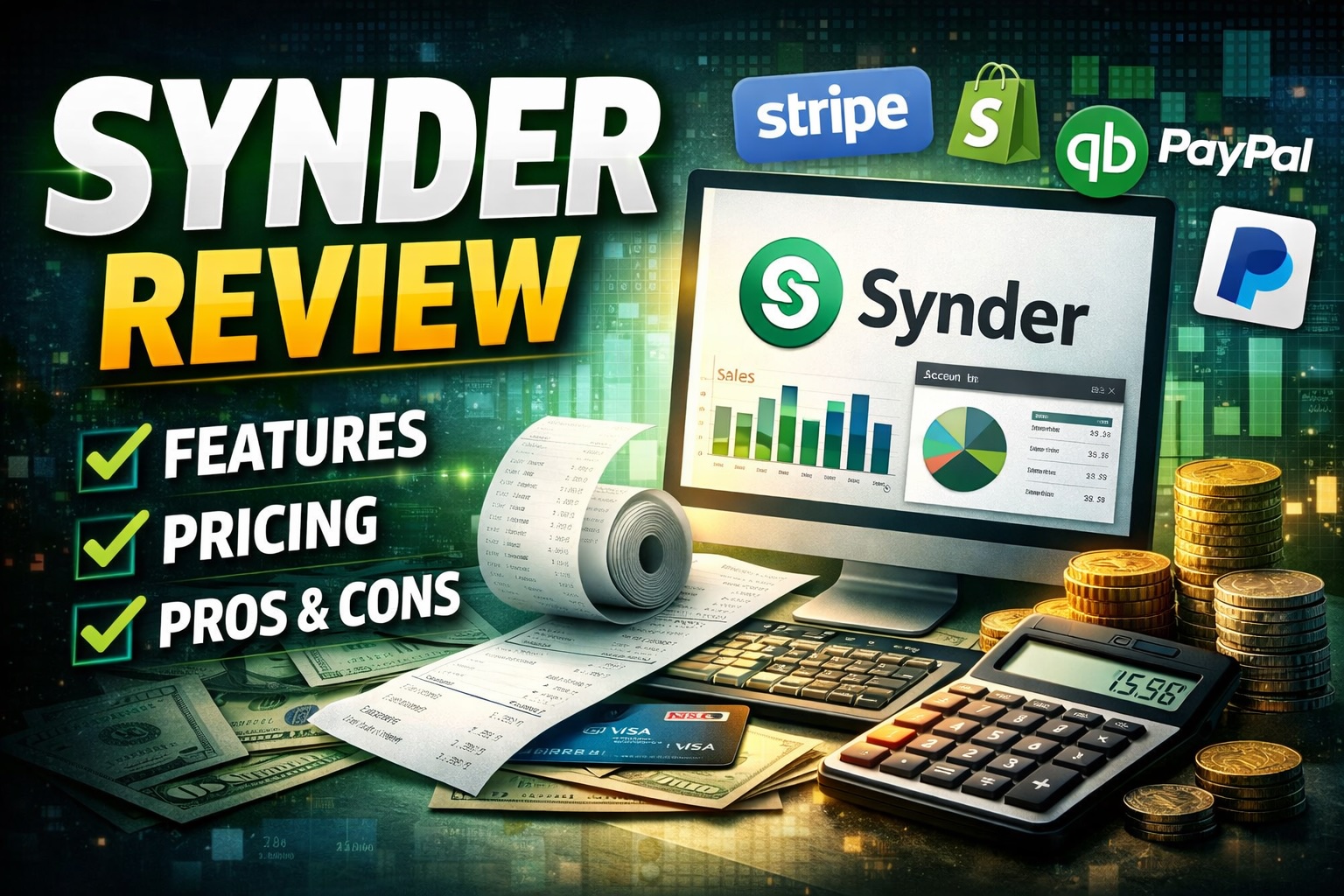
If you are managing multiple payment platforms, reconciling transactions manually can quickly become one of the most time-consuming parts of accounting. This Synder review looks at whether the tool actually solves that problem in a reliable and scalable way.
Synder is designed to automate bookkeeping workflows by syncing sales data from platforms like Stripe, Shopify, PayPal, and others directly into accounting software. But how well does it perform in real-world use, and is it worth the cost?
In this review, I will walk through Synder features, pricing, use cases, pros and cons, and how it compares to alternatives, so you can make a clear decision.
What is Synder? Synder is an accounting automation tool that connects payment platforms, ecommerce systems, and CRMs with accounting software like QuickBooks and Xero. It automatically records transactions, categorizes data, and simplifies reconciliation to reduce manual bookkeeping work and improve financial accuracy.
What Is Synder?
Synder is a financial automation platform focused on one core problem: keeping your accounting records accurate when you are selling across multiple channels.
Instead of exporting CSV files or manually entering transactions, Synder connects directly to payment processors and sales platforms. It then pushes structured, categorized data into accounting tools like QuickBooks Online or Xero.
The platform supports a wide range of integrations, including Stripe, PayPal, Shopify, Amazon, Square, WooCommerce, and more. This makes it particularly relevant for ecommerce businesses, SaaS companies, and agencies handling client revenue streams.
Its main promise is simple: eliminate manual reconciliation and ensure your books match real-world cash flow.
Synder review: Core Features
To understand whether Synder is worth it, you need to look closely at what it actually does day-to-day. These are the core features that define the platform.
Automatic Transaction Sync
Synder automatically imports transactions from connected platforms into your accounting system. This includes sales, fees, refunds, taxes, and payouts.
What stands out is that it does not just import totals. It replicates transaction-level detail, which is critical if you need audit-ready books or want to track performance accurately.
Smart Categorization
The platform allows you to define rules for categorizing transactions. For example, you can assign specific payment types to revenue accounts or automatically separate fees and taxes.
This reduces the need for manual corrections later, especially when dealing with high transaction volume.
Multi-Channel Reconciliation
One of Synder’s strongest features is reconciliation. It matches payouts from payment processors with individual transactions recorded in your accounting system.
This is particularly useful for platforms like Stripe or PayPal where payouts include multiple transactions and fees.
Historical Data Sync
Synder allows you to import historical data, not just new transactions. This means you can backfill your accounting records if you are setting up the tool after months of activity.
However, depending on volume, this can take time and may require careful setup to avoid duplication.
Detailed Reporting Support
Because Synder pushes structured data into your accounting system, it indirectly improves reporting. You get clearer financial insights inside QuickBooks or Xero without needing additional tools.
That said, Synder itself is not primarily a reporting platform. Its strength is data accuracy, not analytics.
Synder review: Use Cases
Synder is not a general-purpose accounting tool. It is designed for specific workflows where transaction complexity creates problems.
- Ecommerce businesses using Shopify, Amazon, or WooCommerce with multiple daily transactions
- SaaS companies handling recurring payments through Stripe or PayPal
- Agencies managing client revenue streams and needing clean bookkeeping
- Accountants and bookkeepers handling clients with fragmented payment systems
- Online businesses operating across multiple currencies and platforms
If your business only processes a few transactions per month, Synder may be unnecessary. But as soon as volume increases, the time savings become more noticeable.
Synder Pricing
Synder pricing is based primarily on transaction volume and features. The platform offers several tiers, typically structured around how many transactions you sync per month.
At the time of writing, pricing generally includes:
- Entry-level plan for small businesses with lower transaction limits
- Mid-tier plans for growing ecommerce and SaaS businesses
- Higher-tier plans for large-scale operations with advanced needs
There is usually a free trial available, which is important because setup quality directly affects results.
One thing to note is that costs can increase quickly if your transaction volume grows. This is a common concern in Synder reviews and something to factor into long-term budgeting.
If you are unsure about current pricing details, it is best to check directly on the official website, as plans and limits can change.
Synder Pros and Cons
Pros
- Strong automation for transaction syncing across multiple platforms
- Accurate reconciliation with detailed transaction-level data
- Wide integration support including major payment processors and ecommerce platforms
- Reduces manual bookkeeping workload significantly
- Supports historical data imports for backfilling accounts
Cons
- Pricing can become expensive as transaction volume increases
- Initial setup requires careful configuration to avoid errors
- Limited native reporting capabilities compared to analytics tools
Overall, the strengths are clear in automation and accuracy, while the weaknesses mainly relate to cost and setup complexity.
Synder vs Competitors
To properly evaluate Synder, it is important to compare it with alternatives like A2X and Zapier, which are often considered in similar workflows.
Synder vs A2X
A2X is another popular ecommerce accounting tool, particularly strong with Amazon and Shopify integrations.
The key difference is that A2X focuses more on summarized data rather than transaction-level detail. Synder, on the other hand, provides more granular data, which can be better for businesses that need detailed records.
If you want simplified summaries, A2X may be sufficient. If you need full transaction visibility, Synder is generally the stronger option.
Synder vs Zapier
Zapier is a general automation tool that can connect apps, including accounting platforms.
However, Zapier is not built specifically for accounting. While it can move data between systems, it lacks the reconciliation logic and accounting-specific structure that Synder provides.
For financial workflows, Synder is more specialized and reliable. Zapier is better suited for broader automation tasks outside of accounting.
Other alternatives like QuickBooks integrations or native platform tools may also be considered, but they often lack the depth and flexibility Synder offers.
FAQ
Is Synder worth it?
Synder is worth it if you process a high volume of transactions across multiple platforms. It can save significant time and reduce errors. For very small businesses, the cost may outweigh the benefits.
How to use Synder?
You start by connecting your payment platforms and accounting software. Then you configure rules for categorization and synchronization. After setup, the system runs automatically with minimal manual input.
Does Synder work with QuickBooks and Xero?
Yes, Synder integrates directly with both QuickBooks Online and Xero. These are two of its primary accounting integrations and are central to how the platform operates.
What platforms does Synder support?
Synder supports a wide range of platforms including Stripe, PayPal, Shopify, Amazon, Square, and WooCommerce. Integration coverage is one of its strongest features.
Can Synder handle historical data?
Yes, Synder allows you to import past transactions. However, this should be done carefully to avoid duplication or incorrect categorization during setup.
Is Synder Worth It?
The answer depends largely on transaction volume and complexity.
If you are running a business with multiple payment systems, high transaction frequency, and a need for accurate books, Synder can deliver real value. It reduces manual work, improves data accuracy, and simplifies reconciliation.
However, if your operations are simple or low-volume, the pricing structure may feel excessive. In those cases, basic integrations or manual processes might still be sufficient.
Overall, Synder is best suited for growing or established online businesses rather than early-stage setups.
Final Verdict
Synder is a focused and capable tool that solves a specific but important problem in modern accounting. Its strength lies in automation, accuracy, and integration depth rather than flashy features.
For ecommerce and SaaS businesses, it can become a core part of the financial workflow. For smaller operations, it may be more than you need.
Overall Rating: ★★★★☆ (4.5 / 5)